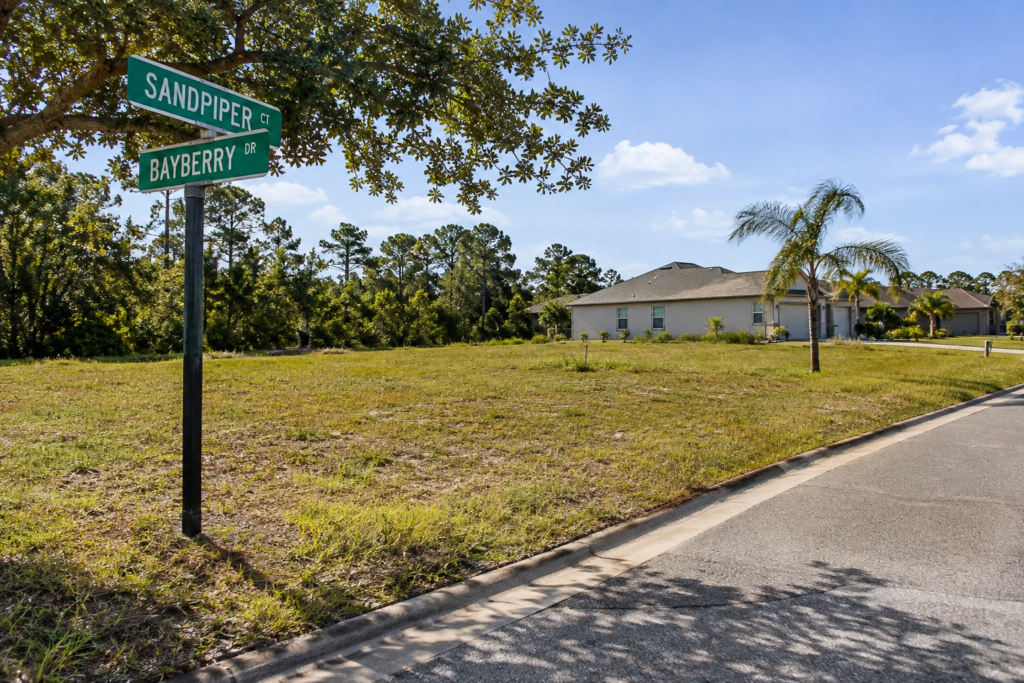
If you have searched for affordable land in Florida, you have almost certainly come across lots in places like Lehigh Acres, North Port, Port Charlotte, Sunny Hills, Marion Oaks, Interlachen, or Flagler Estates. These communities have thousands of quarter-acre and half-acre lots, often at prices that look too good to pass up, and many have no HOA.
Many of these lots are great buys. Some are not buildable without extra cost, and a few are not buildable at all. The difference usually comes down to a handful of things you can check before you sign a contract. This guide walks through what makes these subdivisions different and the checklist we use when helping buyers evaluate a lot.
What Is a Pre-Platted Subdivision?
From the 1950s through the 1970s, land companies bought large tracts across Florida, drew up subdivision plats with thousands of small lots, and sold them nationwide, often by mail with a small down payment and monthly installments. General Development Corporation, for example, created communities including Port Charlotte, North Port, Port St. Lucie, and Palm Bay. Lehigh Acres in Lee County began the same way in the 1950s.
The lots were legally created on paper, but in many places the roads, drainage, water, and sewer were built only in some sections, or not at all. Planners sometimes call these “antiquated” or “premature” subdivisions. Decades later, some neighborhoods have filled in with homes, paved roads, and city water, while others are still mostly woods with a grid of dirt roads or no roads at all.
That history is why two lots a mile apart in the same community can have very different values and very different costs to build on.
Why Buyers Like These Lots
There are good reasons these lots stay popular:
- Price. A platted lot is often one of the most affordable ways to own land in Florida.
- Already subdivided. You are not paying to survey and split a larger tract, and the lot has its own legal description and parcel ID.
- Often no HOA. Many of these communities have no homeowners association, which gives you more flexibility on what and when you build.
- Growth. Several of these areas, especially in Southwest Florida, have seen steady home building as cities and counties extend roads and utilities.
The trade-off is that the due diligence matters more than it would for a lot in a newer, fully developed subdivision.
The Pre-Platted Lot Checklist
Before you make an offer, or during your due diligence period, work through these items. Our broader guide on what to know before buying land in Florida covers the general basics; the points below are the ones that come up most often with platted lots.
1. Road Access
Confirm the lot fronts a road that actually exists and is maintained by the county or city. Some platted roads were never built, and some are private dirt roads that the county does not maintain. A lot on an unbuilt “paper road” may require you to pay for road construction before you can get a building permit, or you may not be able to get one at all. Check the county’s road maintenance map and drive (or walk) the access yourself.
2. Water and Sewer
Find out whether the lot can connect to public water and sewer or will need a private well and septic system. If utilities are available, ask the utility for connection and capacity fees, which can add thousands of dollars to your build. If you will need a well and septic, the septic permit depends on the lot’s soils, the water table, and the lot size, so a soil test (often called a perc test) and a call to the county’s septic permitting office are worth doing before you close.
3. Lot Size and Buildability
Small platted lots, often a quarter acre or less, can run into minimum-size rules for septic systems, setbacks, or zoning. In some cases, you may need to buy an adjoining lot to build. If you are not sure how a lot’s dimensions translate into usable space, our post on how big an acre really is helps put it in perspective. Ask the county planning or zoning office whether the lot is buildable as platted and what the setbacks are.
4. Flood Zone and Wetlands
Look up the lot on the FEMA flood map and the county’s GIS. A lot in a special flood hazard area can still be built on, but it may require fill, a raised foundation, and flood insurance. Lots that are partly or fully wetlands can be expensive or impossible to build on because of permitting. Low, wet lots are often the cheapest in a community for a reason.
5. Special Assessments and the Tax Bill
Many of these communities fund roads, drainage, fire service, or other services through non-ad valorem assessments that appear on the property tax bill, separate from the regular property tax. North Port, for example, has a road and drainage district assessment on lots. These amounts are usually modest, but they apply every year whether you build or not, so look at the full tax bill on the county tax collector’s website, not just the assessed value.
6. Impact Fees and Building Costs
When you pull a building permit, most Florida counties and cities charge impact fees for roads, schools, parks, and other services. Combined with utility connection fees, a well and septic system, clearing, and any fill, these site costs can rival the price of the lot itself. Get rough numbers before you buy so the lot fits your total budget, not just your purchase budget.
7. Title and Back Taxes
Lots that have changed hands many times, or been sold at a tax deed auction, sometimes come with title problems. Order a title search and buy owner’s title insurance, and check whether any property taxes or assessments are delinquent.
8. Deed Restrictions and Zoning
“No HOA” does not mean “no rules.” Some platted communities have recorded deed restrictions, and every lot has zoning that controls what you can build, whether mobile or manufactured homes are allowed, and whether you can keep livestock or park an RV. Read the recorded plat and restrictions and confirm the zoning with the county.
How to Judge the Price
Prices in these communities vary a lot. A cleared lot on a paved road with city water nearby can sell for several times the price of a wooded lot on an unimproved road in the same community. Canal-front and corner lots usually carry a premium.
Compare a lot against recent sales of similar lots, meaning the same community, a similar location within it, and similar access and utilities. Asking prices on portals are not sales. Our Florida land price per acre guide gives the bigger picture, but for platted lots, recent sales on the same street or section tell you far more than per-acre averages.
Questions to Ask the Seller or Listing Agent
Before you write an offer, ask:
- Has the lot been surveyed, and are the corners marked?
- Is there a soil or perc test on file?
- Are public water and sewer available at the lot line, and what are the connection fees?
- What is the full annual tax bill, including assessments?
- Is any part of the lot in a wetland or a high-risk flood zone?
- Is the road county-maintained?
A good listing will answer most of these up front. If the seller cannot answer them, build in time to check them into your contract with a due diligence period.
Should You Use an Agent to Buy a Platted Lot?
Many platted lots are sold online with little more than a photo and a parcel number. That can work fine, but it puts all of the checking on you. Working with a buyer’s agent for land gives you someone who knows which questions to ask, how to read the county records, what similar lots have actually sold for, and who can write a contract with the right protections.
Ready to Find the Right Lot?
Scott lists and sells lots in many of Florida’s platted communities, including Lehigh Acres, North Port, Port Charlotte, Sunny Hills, Marion Oaks, and Interlachen, and helps buyers sort the good lots from the expensive surprises. If you are looking at a lot, or want help finding one that fits your plans and budget, contact Scott at Best Land Agent for a no-pressure conversation.
