
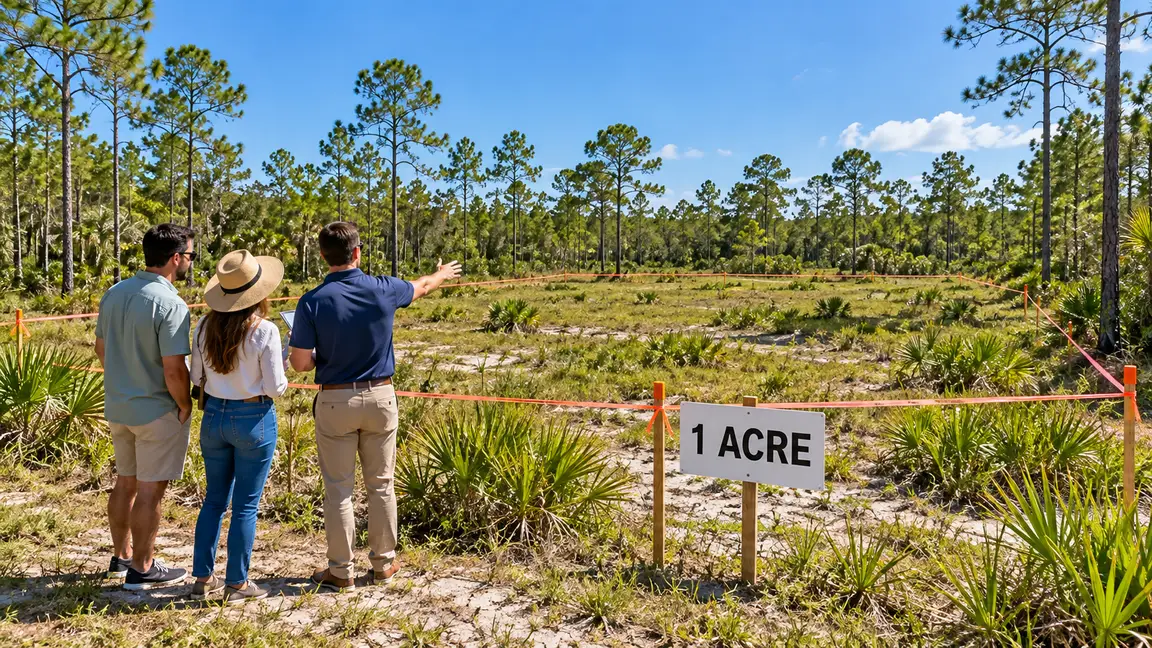
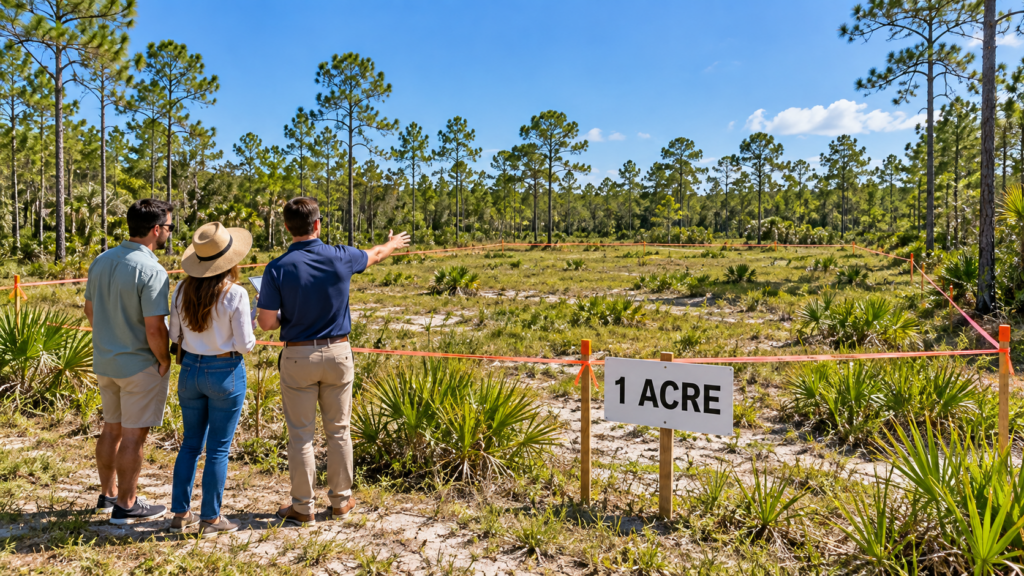
Whether you’re scrolling land listings or getting ready to list your own parcel, one question comes up constantly: how big is an acre, really? The number on a listing sounds simple. In practice, it’s one of the most misunderstood measurements in Florida real estate, and misreading it can cost buyers money and cost sellers offers.
How Big Is an Acre?
An acre is 43,560 square feet. That’s the same everywhere in the United States, including Florida. If it were a perfect square, each side would be about 208.7 feet long. Most parcels aren’t perfect squares, of course, so a 1-acre lot might be 150 feet wide and 290 feet deep, or a long narrow strip.
A few comparisons help make it real:
- An American football field (end zones included) is roughly 1.3 acres.
- A standard Florida suburban lot is often around a quarter acre (10,890 square feet), so four of those make an acre.
- A typical large rural homesite might run 1 to 5 acres, while recreational and agricultural tracts often start at 10 and go up from there.
Keep in mind that size by itself tells you very little about what you can actually do with the land.
Fractions of an Acre: Reading Florida Listings
Florida has a huge inventory of platted subdivisions where lots are sold in fractions of an acre. You’ll often see parcels listed as 0.23, 0.25, or 0.5 acres in places like Lehigh Acres, North Port, and Port Charlotte, and as 1.25 or 2.5 acres in more rural platted communities. These are very different products from a 20-acre rural tract, even though both are “land.”
Small platted lots tend to appeal to builders and buyers who want a homesite, while larger acreage draws buyers thinking about recreation, hobby farming, or long-term holding. That difference matters because the buyer pool, the financing options, and the way the property should be marketed all change with size.
Gross Acres vs. Usable Acres
Here’s where acreage gets tricky. A listing may say 10 acres, but that figure usually describes the total deeded area. It doesn’t promise 10 usable acres. In Florida, a meaningful part of a parcel may be:
- Wetlands, which are heavily regulated and can limit or prevent building
- In a flood zone, which affects insurance, lending, and where a structure can go
- Covered by easements, such as utility or access easements that cross the property
- Landlocked or poorly accessed, so part of the acreage can’t be reached practically
Two 5-acre parcels can have completely different value if one is high, dry, and on a maintained road while the other is mostly wet and reachable only by an unrecorded dirt track. When you compare listings, ask how much of the parcel is truly buildable or usable.
Why Acreage Doesn’t Translate Neatly Into Price
Many buyers search “how much is an acre in Florida” hoping for a single number. There isn’t one, because land value varies by county, access, utilities, zoning, and the size of the parcel itself. Larger parcels often sell for a lower price per acre than small ones, while a small, build-ready lot with utilities can carry a higher per-acre price than a much bigger tract with no road access.
For a county-by-county look at how values really compare, see our 2026 Florida price-per-acre guide. Treat any per-acre average as a starting point rather than a verdict on one specific parcel.
Tips for Buyers
Before you get attached to a listing’s acreage:
- Confirm the acreage in the records. Check the county property appraiser’s parcel data and the legal description rather than relying only on the listing.
- Order a survey when the stakes justify it. Boundaries, encroachments, and easements are far easier to deal with before closing than after.
- Check zoning and minimum lot requirements. Some zoning classifications set minimum lot sizes for building, so a parcel that’s “too small” may not be buildable as-is.
- Ask about access and utilities. Legal, recorded access and the availability of power, water, and septic or sewer shape what the land can become.
Tips for Sellers
If you’re the one selling, accurate acreage is part of your credibility with buyers.
Make sure the size in your listing matches the legal description and county records. If you’re not sure, a survey can settle it and may prevent a deal from stalling during due diligence. Then be upfront about how much of the acreage is usable. A buyer who discovers late that half the parcel is wetland is far more likely to renegotiate or walk away than one who knew from the start.
Acreage should also inform how you set your asking price. Comparing your parcel to similar-size land with similar access, utilities, and zoning is far more reliable than applying a generic per-acre figure. We walk through that process in our guide to pricing your land correctly.
When to Bring in a Land Specialist
Acreage questions are rarely just about math. They touch zoning, title, access, flood zones, and local buyer demand, and those are exactly the areas where a land-focused agent earns their keep. If you’re weighing listing your land with an agent, a good specialist will help you confirm the real size and usable area, position the property to the right buyer pool, and price it based on what comparable parcels have actually done.
For buyers, the same expertise helps you avoid paying a premium for acres you can’t use.
Ready to Talk Through Your Parcel?
Whether you’re trying to understand the acreage you own or evaluating a parcel you’re considering, I’m happy to help you sort out what the numbers really mean. Contact us and let’s talk through your situation.
