
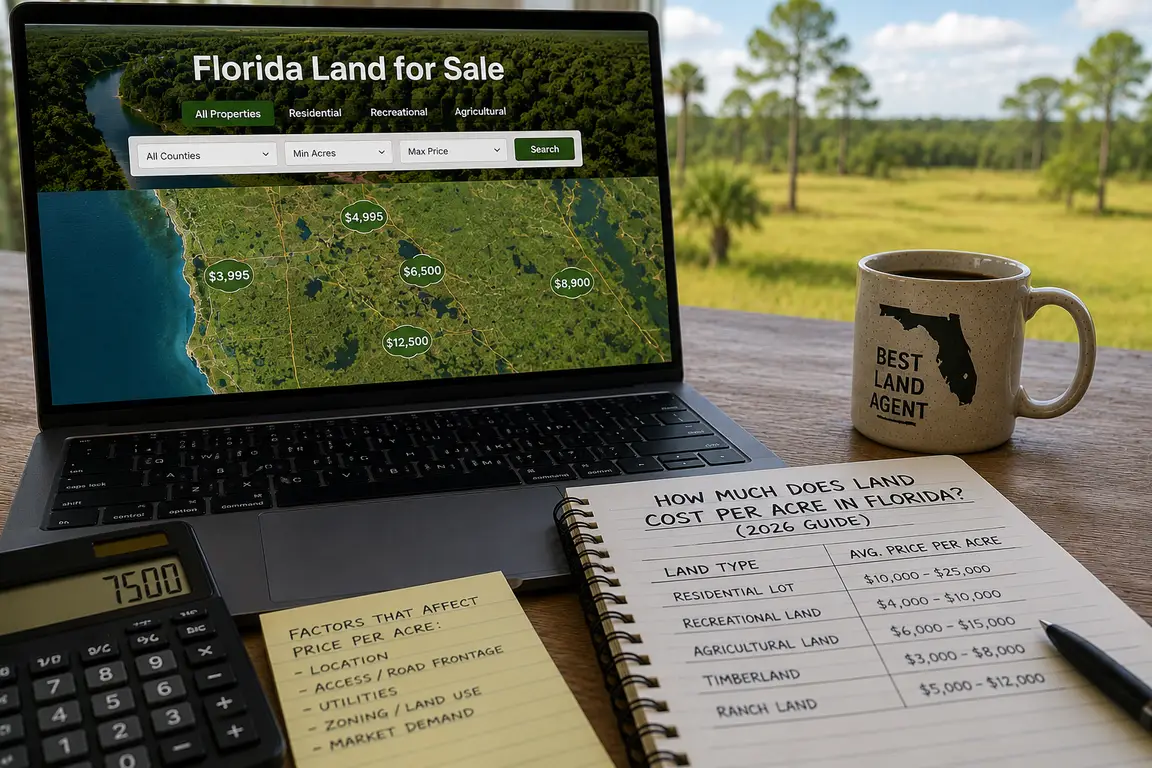
Type “how much is an acre of land in Florida” into Google and you’ll get a dozen different answers, because there isn’t one number — and if you’ve been quoted a single statewide figure, take it with a grain of salt. An acre in the Panhandle can cost less than a used car. An acre in Miami-Dade can cost more than most people’s houses. Both are “Florida land,” and both are technically correct answers to a question that’s really asking about a specific place, not a whole state. See which Florida counties land buyers are actually searching in.
Here’s what the actual 2024–2025 sales data shows, broken down the way a buyer or seller actually needs it: by region, by county, and by what’s driving the number.
Florida’s Statewide Median: $74,000 Per Acre
Based on recorded vacant residential land sales across all 67 Florida counties from January 2024 through December 2025 (Florida Department of Revenue data), the statewide median price per acre for buildable residential land is $74,000. This is the most recent full-year benchmark available as of late 2026 — FDOR’s 2026 sales data won’t be finalized until early 2027, so treat any site quoting a full-year 2026 statewide figure today with skepticism. A separate look at all land types — including rural, agricultural, and recreational acreage — puts the broader statewide average closer to $22,500–$33,000 per acre, which tells you most of the acreage in Florida isn’t residential lot inventory; it’s larger rural and ag tracts pulling the average down.
Both numbers are “correct.” The gap between them is the whole story: Florida land pricing depends enormously on what the land is and where it sits, more than almost any other state.
Year over year, prices have leveled off rather than kept climbing. The 2024 statewide median ($74,176/acre) and 2025 statewide median ($73,913/acre) came in essentially flat — a sign the rapid appreciation of 2021–2022 has settled into a more normal market.
Price Per Acre by Region
North Florida & the Panhandle
This is the most affordable part of the state by a wide margin, and it’s also where an experienced Florida land agent can make the biggest difference in getting you a fair price — thin comps mean off-market deals and outdated tax-roll estimates are common. Many counties here sell for well under $20,000 per acre, and the five cheapest counties in Florida — Holmes ($7,700/acre), Calhoun ($8,200/acre), Jackson ($8,800/acre), Madison ($10,100/acre), and Hamilton (~$12,300/acre) — are all up here. If you’ve got $74,000 to spend, that’s 7 to 9 acres of buildable land in this region.
Jackson County is worth calling out specifically for Best Land Agent buyers: it’s home to Compass Lake, where wooded lots trade in the low five figures per acre — right in line with the regional median.
Central Florida
Central Florida runs a much wider range — typically $50,000 to $100,000 per acre for residential-grade land, with the same $74,000 buying roughly one acre instead of seven or eight. Counties like Marion ($52,600/acre), Sumter ($57,100/acre), and Lake (~$76,900/acre) sit squarely in this band, driven by steady suburban growth pressure without the scarcity pricing of the coasts.
South Florida & Coastal Metros
This is where the state’s most expensive land sits, and the range is enormous. how to price land correctly for today’s market. Miami-Dade tops the state at roughly $3.18 million per acre, followed by Monroe ($1.43M), Pinellas ($1.38M), Martin ($1.2M), and Palm Beach ($925,000). At those prices, $74,000 buys something closer to 1,000 square feet than an acre.
Charlotte County — where Best Land Agent has active listings around Port Charlotte — runs closer to the state median at roughly $82,600 per acre, and Washington County (home to Sunny Hills) sits in the more affordable mid-range alongside its Panhandle neighbors.
What Actually Moves the Price
A handful of factors explain most of the swing between an $8,000/acre parcel and a $3 million/acre parcel:
Location relative to metro areas. Distance from Miami, Tampa, or Orlando compresses or expands pricing more than any other single factor.
Land use and zoning. Residential and commercially-zoned parcels sit well above agricultural or purely recreational acreage on comparable ground.
Utilities and access. Paved road frontage and utility hookups can add real money per acre, sometimes even within the same zip code.
Environmental constraints. Flood zones, wetlands, and conservation easements pull prices down; waterfront and lake access push them up.
Sales volume and liquidity. Counties like Lee (over 8,000 residential land sales in two years) and Charlotte have deep, active markets that tend to price more predictably than thin, low-volume rural counties.
How Buyers Should Use This Data
If you’re shopping for land, use the county median as a sanity check, not a hard rule. A listing priced well above its county’s median needs a reason — waterfront, paved access, a favorable zoning designation — and if you can’t find that reason, it’s worth asking about. Conversely, a price well below median in a low-volume county isn’t automatically a deal; check whether it’s landlocked, wetland-heavy, or missing legal access before you get excited about the number.
How Sellers Should Use This Data
Pricing your land against a statewide average is one of the fastest ways to leave money on the table or scare off buyers with an unrealistic number — the range between a Panhandle acre and a coastal acre is roughly 400x. Your county’s actual median, adjusted for your parcel’s specific access, zoning, and utilities, is a far more useful starting point than any statewide figure. For a deeper walkthrough of how to translate that into an actual listing price, see our guide on how to price Florida land for sale, and check which Florida counties buyers are searching for most in 2026 to see how your area is trending.
Get a Real Number for Your Parcel
Countywide medians are a useful starting point, but they’re not a substitute for a professional read on your specific piece of land. If you want to know what your Florida parcel is actually worth in today’s market — not the county average — get a free land valuation or contact Scott directly to talk through your options, whether you’re buying or getting ready to list.
