
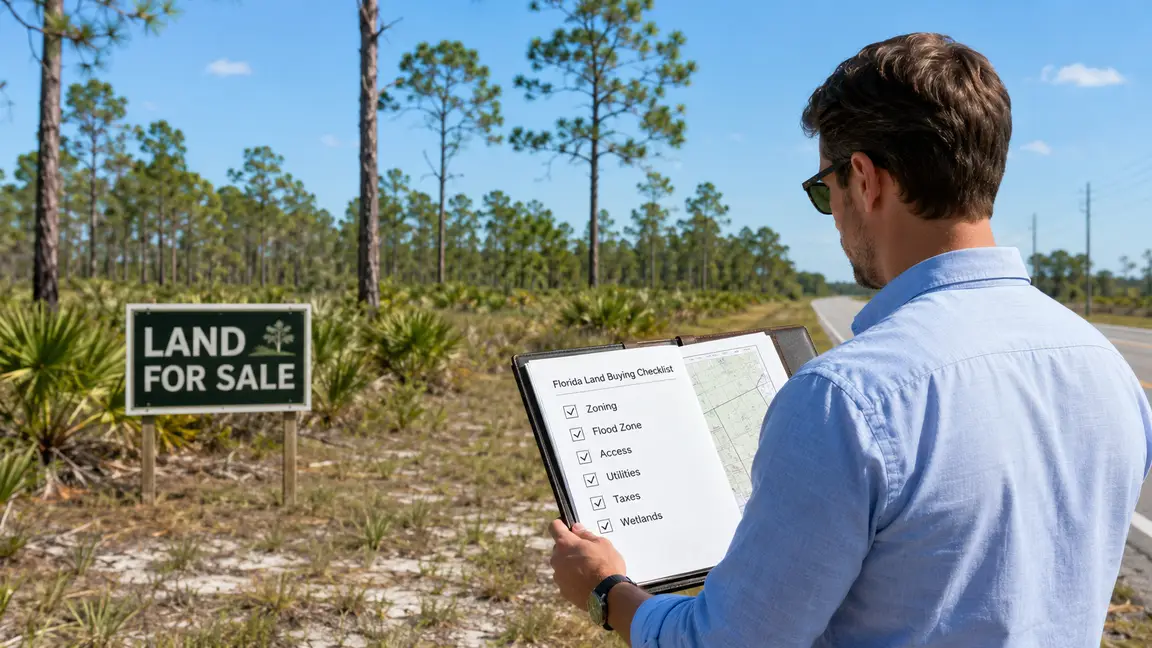
Buying raw land in Florida looks simple on the listing photo: a clearing, a tree line, a price. The reality is that vacant land is one of the easier real estate purchases to over-pay for and one of the easier ones to get stuck with if you skip the due diligence. There is no roof to inspect, no kitchen to walk through — but there are dozens of small things that decide whether the parcel is actually buildable, financeable, and worth what you are paying.
This is a practical 2026 guide to what a Florida land buyer should check before signing. It covers the questions that matter regardless of whether you are buying a half-acre lot to build a home, a 40-acre tract for hunting and recreation, or a rural parcel as a long-term investment.
1. Know the Florida Land Market You’re Buying Into
Florida is not one land market — it is at least three.
Coastal and South Florida acreage commands a premium driven by population growth and limited inventory. Central Florida (the I-4 corridor, the Heartland counties, the Space Coast hinterland) sits in the middle, with strong appreciation in counties absorbing residential development. North Florida and the Panhandle remain the most affordable parts of the state, with several counties still under $10,000 per acre on the open market.
Statewide, the average price per acre across all Florida land types runs around $22,500 in 2026, with rural ranch and recreation properties between 50 and 500 acres averaging closer to $9,000 per acre, and very large tracts over 500 acres in the $6,000–$7,000 per acre range. Smaller infill lots in growing subdivisions can run dramatically higher on a per-acre basis simply because they are sold as buildable homesites, not as agricultural acreage.
Before you put in an offer, look at recent sold comparables — not listings — in the same county and the same property class (buildable subdivision lot vs. agricultural acreage vs. timberland). Asking prices in Florida land can sit well above market for a long time without selling. If you would like a quick read on a specific parcel, request a free land valuation before making a decision.
2. Confirm What You Are Allowed to Do With the Land (Zoning)
The single most common mistake first-time Florida land buyers make is assuming a parcel is buildable because it looks buildable. Zoning controls what you can do.
Before you make an offer, get a written answer from the county planning or zoning department on:
- The current zoning classification of the parcel
- Whether your intended use (single-family home, manufactured home, agricultural, recreational, short-term rental, etc.) is allowed by right or requires a variance
- Minimum lot size and setbacks
- Maximum building height and impervious surface coverage
- Any pending zoning or comprehensive-plan changes for that area
Many Florida counties also have separate overlay districts — for example, conservation overlays, coastal high-hazard areas, or rural-agricultural districts — that layer additional restrictions on top of the base zoning. The base zoning might allow a house; the overlay might not.
3. Check Wetlands, Conservation, and Environmental Constraints
Florida is a wet state. A non-trivial percentage of any rural parcel can fall under jurisdictional wetlands governed by the South Florida Water Management District, the St. Johns River Water Management District, or the U.S. Army Corps of Engineers, depending on location. Wetlands do not necessarily kill a deal — but they can shrink the buildable footprint, require expensive mitigation, or block development entirely on small parcels.
What to check:
- Pull the property up in the county GIS and look at the wetlands and surface-water layers
- Order or review a wetlands delineation if any portion of the parcel looks low, ponded, or vegetated with cypress, bay, or tupelo
- Check for conservation easements recorded against the property — those run with the land and bind future owners
- Confirm whether any portion is in a designated Outstanding Florida Water buffer or species-protection zone (Florida scrub-jay, gopher tortoise, panther, and several others can affect development approvals)
If wetlands are present, a real estate agent who works with land — not houses — should walk you through how much of the parcel is actually usable.
4. Verify Legal and Physical Access
A parcel without legal access is worth a fraction of one with it. “Legal” access means a recorded right to reach the property from a public road — either direct frontage, a recorded easement across a neighbor, or a dedicated platted right-of-way. “Physical” access means there is actually a usable road or path you can drive on.
Both matter. Some Florida parcels — especially older subdivisions in places like Flagler Estates, Suburban Estates, and parts of Highlands and Hendry counties — have legal access on paper but no graded road in reality, which means you would be responsible for building one if you ever want to live there.
Ask before closing:
- Is the parcel on a maintained county road, a private road, or a paper-only right-of-way?
- If it is on a private road, is there a road maintenance agreement?
- Is there recorded easement language giving you the right to cross neighboring land if needed?
5. Look at the Flood Zone Designation
FEMA flood zone designations directly affect insurance cost, financing, and resale. Before you buy, pull the parcel’s flood zone from the FEMA Map Service Center or your county property appraiser’s site.
A few rules of thumb in Florida:
- Zones X (or X500) are the most desirable — minimal flood risk
- Zones A, AE, AH, and AO are inside the 100-year floodplain — flood insurance will be required if you finance, and any structure will need to be elevated
- Zone VE (coastal high-velocity wave action) is the most restrictive and most expensive to build in
Flood zones get updated. Older listings sometimes still show the prior designation, so verify against the current FEMA map before relying on it.
6. Understand Utilities and What Bringing Them In Will Cost
On rural Florida land, “utilities” usually means well, septic, and either a power-pole drop or a long run from the nearest line. Each one is a real cost line item that buyers often forget to budget.
Get current quotes (2026 prices vary by county, but typical ballpark figures):
- A new well in most of Florida runs $5,000–$15,000, depending on depth and casing requirements
- A new septic system on a permitted lot generally runs $8,000–$15,000, more if the soil requires a mound system
- Electric service: if the nearest power pole is more than a couple of hundred feet away, the utility company will charge per foot for the line extension — this can run into five figures fast on a deep tract
- Internet: confirm whether fiber, fixed wireless, or only satellite is available; this affects resale, especially for remote-work buyers
If you are paying cash and willing to camp on the land, you can phase these in. If you are financing a build, the lender will want a clear cost-to-build estimate that includes utility hookups.
7. Title, Survey, and the Closing Process
Once you have an accepted contract, a few items determine whether the closing goes smoothly:
- Order a title commitment early. It will surface any liens, easements, mineral reservations, or probate gaps. Florida land has a lot of long chains of title, and unclosed estates from decades ago are common.
- Read Schedule B-II of the title commitment. That is the list of things the title insurance policy will not cover: easements, restrictions, and mineral severances. You want to know what is on there before closing, not after.
- Get a current boundary survey if there is any ambiguity about acreage, frontage, or encroachments. Older surveys can miss fence-line creep, hidden corners, or improvements that crossed onto the parcel.
- Confirm who pays for title insurance. In 63 of 67 Florida counties, the seller customarily pays the owner’s policy and picks the closing agent. The four exceptions (Miami-Dade, Broward, Sarasota, Collier) put it on the buyer by custom. Everything is negotiable in the contract.
For a more detailed walk-through of the documents and closing steps involved, see our post on documents you’ll likely encounter when buying or selling Florida land.
8. Property Taxes and Agricultural Classification
Florida property taxes on vacant land are based on the just (market) value as assessed by the county property appraiser, with no homestead exemption available on raw land. That can be a meaningful annual carry cost on larger or higher-value parcels.
If the land is used in good faith for a commercial agricultural purpose — timber, cattle, hay, row crop, beekeeping, certain aquaculture — it may qualify for an agricultural classification (often called “Greenbelt”) that assesses the property based on its agricultural use value rather than market value. That can cut the assessed value (and the tax bill) dramatically.
You apply through the county property appraiser, and the requirements vary by county and by use. If the existing seller has the classification in place, confirm with the appraiser whether the classification continues automatically for the new owner or has to be reapplied for.
9. Have a Real Land Agent on Your Side
Most residential real estate agents do not specialize in land. The skills that close a typical home sale — staging, pricing strategy, photographing interiors — do not transfer to evaluating a 40-acre tract with mixed wetlands, a paper-only easement, and three decades of unclosed probate in the chain of title.
When buying Florida land, look for an agent who can answer questions about zoning, soil suitability, surveys, and water management districts as fluently as they answer questions about square footage. They will save you from the deals that look good on the listing and are problems on the deed.
Ready to Buy Florida Land?
If you are looking for land in Florida and want to work with an agent who specializes in raw land — not just houses — reach out through our contact page or browse our featured land listings. We help buyers from the first parcel search through closing and can flag the issues that matter before you ever sign a contract.
