
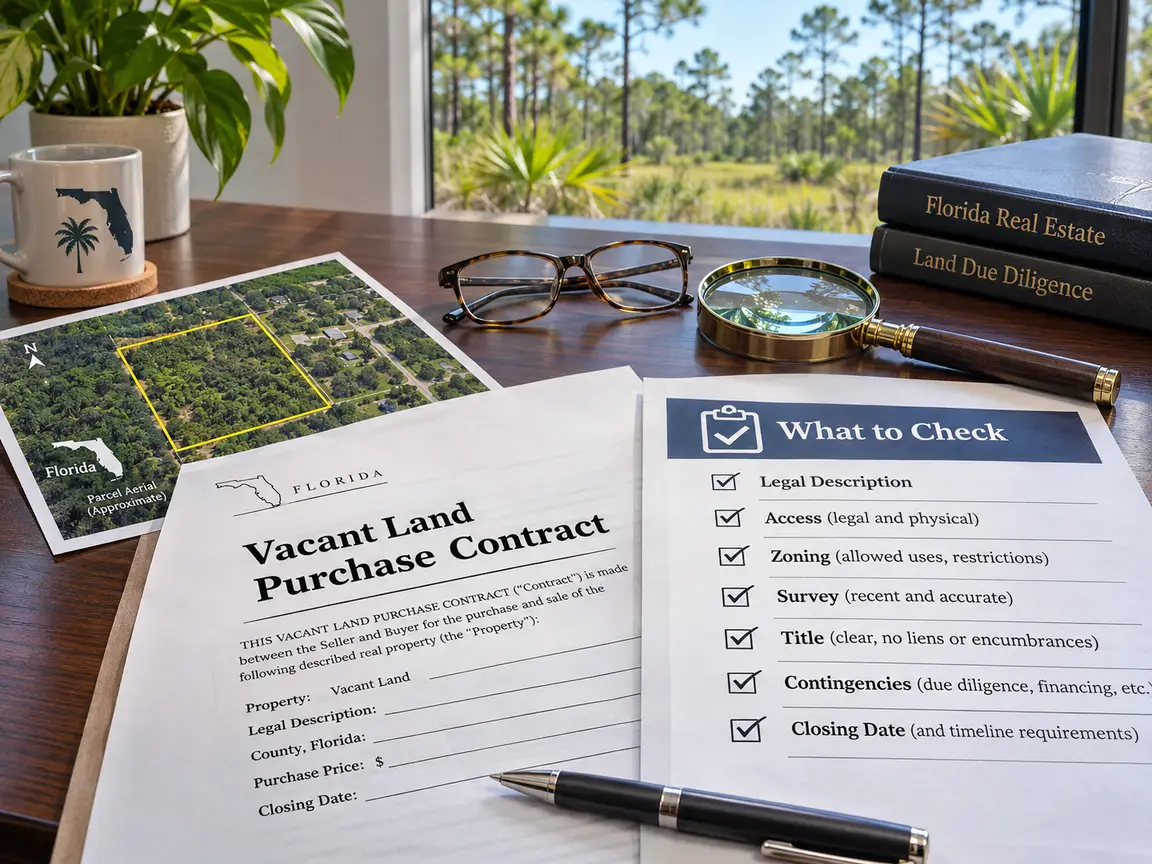
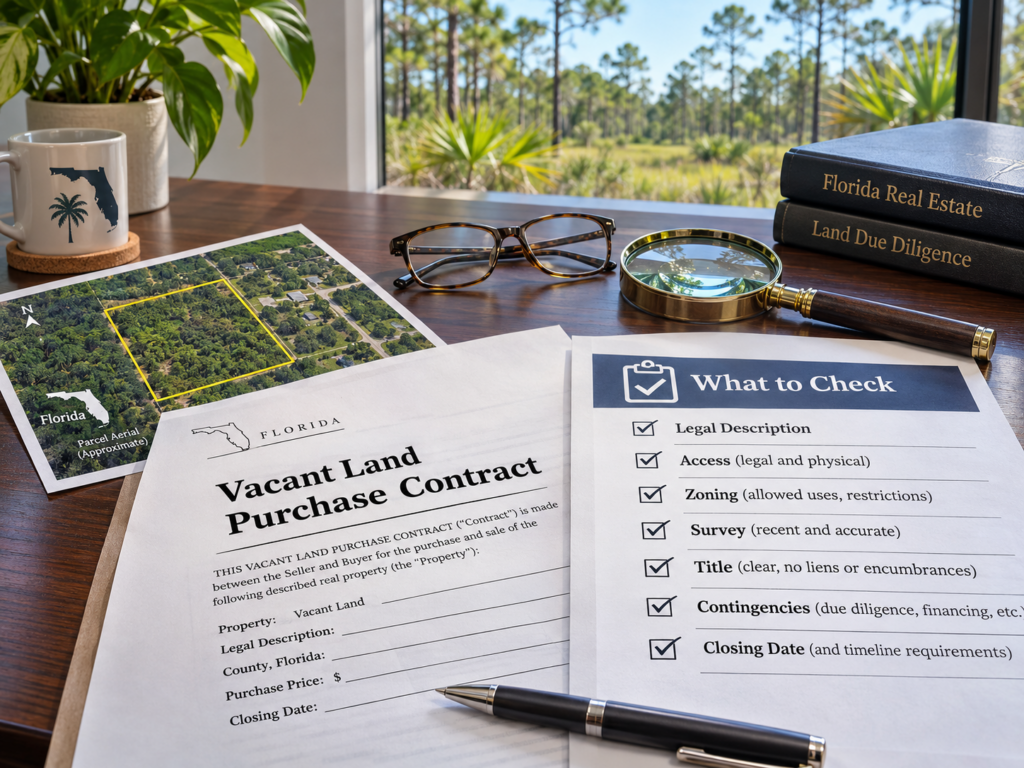
If you are buying or selling vacant land in Florida, the purchase contract is where the deal is really made. The price gets the attention, but the terms around it decide who carries the risk, how long the buyer has to investigate, and what happens if something goes wrong. A land contract is not the same as a house contract, and using the wrong assumptions can cost you money.
This guide walks through what a Florida vacant land purchase contract typically covers, the terms worth reading slowly, and the mistakes we see most often. It is general information, not legal advice. For anything unusual, have a Florida real estate attorney review the contract.
Why land contracts are different from home contracts
A house contract spends a lot of its pages on the building: inspections, roof and air conditioning, repairs, insurance. Vacant land has none of that. Instead, the risk sits in things you cannot see from the road: legal access, utilities, wetlands, flood zones, zoning, boundaries, and title.
That is why Florida agents commonly use a contract written specifically for vacant land rather than a residential form. Florida Realtors and The Florida Bar publish standard forms, and agents choose the one that fits the property. If someone hands you a home contract for an empty parcel, ask why.
The key parts of a Florida land purchase contract
Every contract is different, but most vacant land contracts cover the same core topics.
Parties, property, and price
The contract should name the buyer and seller exactly as they appear on title, describe the parcel by its legal description and parcel number (not just a street or nearby address), and state the price and how it will be paid. Many vacant lots have no street address at all, so a precise description matters.
Deposit
The buyer usually puts down an earnest money deposit that is held by an escrow agent, often a title company or attorney. The contract should say how much, when it is due, and under what conditions it is refundable. Buyers want a clear way to get it back if due diligence turns up a problem. Sellers want to know it is real money.
Due diligence or inspection period
For land, this is the most important section. It gives the buyer a set number of days to investigate the parcel and cancel if they are not satisfied. Buyers typically use it to confirm access, check utilities, review flood and wetland maps, order a survey, check zoning and permitted uses, and, for a lot intended for a septic system, find out whether the site can support one. If the period is too short for what the buyer needs to check, it can be negotiated.
Financing or cash
The contract should state whether the buyer is paying cash or relying on a loan. Land loans are not always as easy to get as home loans, so a financing contingency can matter. If the seller is offering owner financing, that needs its own written terms; our guide to owner financing for Florida land covers the basics.
Title and survey
The seller generally provides evidence of title, often through a title commitment, and the buyer has a window to point out problems. Liens, unpaid taxes, easements, and unclear ownership are common issues on land, especially inherited parcels. If you want to understand how these show up, read our overview of liens in Florida real estate. The contract should also say who orders and pays for a survey, since boundaries on raw land are often not obvious.
Closing date and costs
The contract sets the closing date and who pays which costs. In Florida, the seller commonly pays the documentary stamp tax on the deed, and the buyer commonly pays recording fees and any lender costs, but custom varies by county and everything is negotiable. Title insurance is another item where the contract and local custom decide who pays. For a full picture, see our guide to closing costs when buying or selling real estate in Florida and ask your title company for a current estimate, since rates and fees can change.
Default and remedies
This section says what happens if either side fails to close. Often the seller may keep the deposit if the buyer defaults, and the buyer may be entitled to the deposit back or other remedies if the seller defaults. Read it carefully, since the consequences are spelled out here.
“As is” language
Land is frequently sold as is, but “as is” does not erase a seller’s duty to disclose known material defects that are not readily observable, and it does not erase title problems. If your parcel has a known issue, such as a flood history or an access dispute, disclose it in writing. Our guide to the Florida flood disclosure law for land sellers explains one disclosure sellers should know about.
Terms sellers should read twice
If you are selling, pay particular attention to these items:
- The length of the due diligence period. Longer periods give buyers more room to walk away.
- Any contingencies tied to financing, rezoning, or permits. These can keep your parcel tied up for months.
- Who pays for the survey, title work, and doc stamps, since this changes what you net.
- The closing date and any extension rights.
- Whether any liens, back taxes, or co-owners must be resolved before closing.
Ask your agent for an estimated net sheet before you accept an offer so you compare offers by what you would actually keep, not just the headline price.
Terms buyers should read twice
If you are buying, focus on:
- Whether the due diligence period is long enough to confirm access, utilities, zoning, and flood zone status.
- Whether the deposit is refundable during that period.
- Whether the seller can truly deliver clear title.
- What the legal description includes, and whether a survey will confirm it.
- Any recorded restrictions, easements, or HOA or association rules that limit what you can build.
Common mistakes to avoid
A few mistakes come up again and again. Sellers accept an offer without understanding the contingencies attached to it. Buyers waive or shorten due diligence to look competitive, then discover the parcel has no legal access. Both sides rely on a street address instead of a legal description. Heirs try to sell without every owner signing. And some parties use an informal form found online that leaves out key protections.
Our overview of the documents you’ll likely encounter when buying or selling land is a helpful companion to this guide.
Do you need an agent or an attorney?
Florida does not require you to use an agent to sell land, but a contract is a legal document with real financial consequences. A land specialist can explain the standard terms, help you compare offers, and keep the deal on schedule, while an attorney is the right person to advise on legal questions or unusual structures. Using both on a complicated parcel is often money well spent.
If you are ready to sell, you can list your land with a licensed agent who handles vacant land every day. And if you have a contract in front of you and want a second set of eyes on how the offer compares, contact Scott for straight answers about value, timing, and next steps.
