
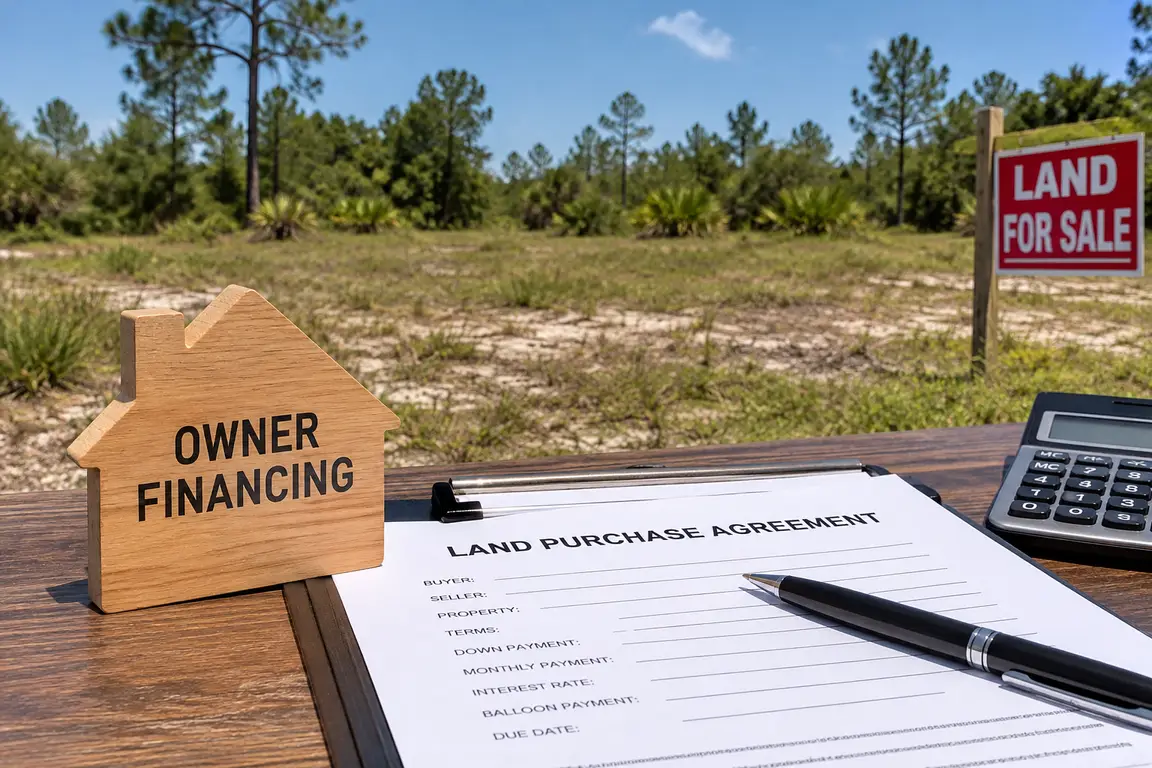
Every few months, a Florida landowner asks me the same question: “A buyer offered to make payments directly to me instead of getting a bank loan — should I say yes?” It’s a fair question, and it comes up more with vacant land than with houses, for a simple reason: banks are far more cautious about lending on raw land than on a home someone will live in.
If you own land in a rural or recreational part of Florida — timberland in the Panhandle, a few acres outside a small county seat, hunting or grazing land away from a metro area — you’ve probably run into buyers who love the property but can’t get a conventional loan for it. That gap is exactly where owner financing lives, and it’s worth understanding before you decide whether to offer it.
What Owner Financing Actually Is
Owner financing (also called seller financing) means you, the seller, act as the bank. Instead of the buyer getting a mortgage from a lender and paying you in full at closing, the buyer makes a down payment and then pays you directly over time under a promissory note, typically secured by a mortgage or deed of trust recorded against the property.
There are a few structures this can take:
- Note and mortgage — the buyer gets the deed at closing, and you hold a recorded mortgage as security, just like a bank would.
- Contract for deed (land contract) — you keep the deed until the buyer pays off the note, then transfer title at the end. This is less buyer-friendly and, in Florida, comes with specific legal requirements sellers need to follow carefully.
- Wraparound mortgage — used when the seller still has their own mortgage on the property and structures the new loan “around” it. This one needs an attorney involved from day one.
Most straightforward land deals use the first structure, with a title company or real estate attorney preparing the note, mortgage, and closing documents the same way they would for a cash sale.
Why This Comes Up More Often on Land Than Houses
Residential mortgage lending is a well-oiled machine. Land lending isn’t. Banks that will happily finance a home often won’t touch a vacant parcel, or they’ll only lend a smaller percentage of the purchase price, require a much larger down payment, or charge a noticeably higher rate than a comparable home loan. Buyers who want acreage for recreation, future building, or agricultural use frequently discover this the hard way partway through a purchase.
That financing gap doesn’t disappear when land prices are flat or falling — if anything, tighter or pricier land lending pushes more buyers to ask sellers directly about terms. For sellers in the lower and mid price ranges of the Florida land market especially, this is a real and recurring part of the buyer conversation, not a fringe scenario.
The Upside for Sellers
Offering owner financing can widen your buyer pool considerably, particularly in counties where land values are modest and buyers are more likely to be individuals than developers or institutional investors. A buyer who can’t qualify for a land loan today, or doesn’t want to deal with one, may be willing to move quickly and pay closer to your asking price if you make the financing easy.
There’s also the income side: a well-structured note pays you interest over the life of the loan, which can add up to more total return than a one-time cash sale, especially if you don’t need the full proceeds immediately for another purchase.
The Trade-offs You Need to Weigh
Owner financing is not free money, and it’s not the right fit for every seller or every property.
- You don’t get paid in full at closing. If you need the proceeds now — to buy your next property, pay off debt, or for any other reason — tying up your equity in a note that pays out over years may not work for you.
- You take on collection and default risk. If a buyer stops paying, Florida foreclosure is a court process, not an instant reversal, and it takes time and legal cost to resolve.
- The paperwork has to be right. A promissory note and mortgage that aren’t drafted and recorded correctly can create real problems later, both for enforceability and for your own liability. This is not a handshake-deal situation.
- You may still owe taxes on the full gain up front in some structures, even though you’re collecting the money over time — this is a conversation for your CPA, not your agent.
None of these are reasons to rule it out. They’re reasons to structure it properly instead of doing it informally.
How This Fits Into a Traditional Listing
Here’s the point I make to every seller who asks about this: owner financing works best as a term you offer within a professionally marketed listing, not as a replacement for one. The property still needs to be priced correctly using real comparable sales, marketed to the widest possible pool of buyers, and closed through a licensed title company — the same as any other sale. Offering financing terms is one more way to make a well-priced listing more attractive; it isn’t a shortcut around doing the marketing and pricing work that gets you top dollar in the first place.
When I help a seller consider this route, that means pulling accurate comps for the area (see our breakdown of how land actually prices across Florida), listing the property normally, and bringing in a title company and, where needed, a real estate attorney to draft the note and mortgage correctly, verify the buyer, and record everything the way a lender would. It also means being honest with you up front about which counties and price points this tends to work well in — see our county-by-county look at where land buyers are actually searching for context on where financing flexibility tends to matter most.
When It Makes Sense — and When It Doesn’t
Owner financing tends to make the most sense when:
- Your land is in a rural or recreational county where conventional land loans are harder for buyers to get.
- You don’t need the full sale proceeds immediately.
- You’re comfortable being patient in exchange for a wider buyer pool and interest income.
It tends to make less sense when:
- You need cash in hand now for your next purchase or another obligation.
- Your property is in a high-demand area near a metro county where cash buyers and conventional financing are already plentiful.
- You’re not willing to have a title company or attorney properly document and record the note.
If you’re weighing this against a straightforward sale, it’s also worth comparing the closing mechanics side by side — our guide to closing costs when buying or selling real estate in Florida covers what a standard closing looks like so you can see exactly what changes with a financed deal versus a cash one.
Talk It Through Before You Decide
Owner financing is a legitimate tool, not a gimmick, and for the right property it can be the difference between a listing that sits and one that sells at a price you’re happy with. But it’s a decision worth making with real numbers and a real conversation, not a quick yes to the first buyer who asks.
If you’re thinking about listing land in Florida and want to know whether offering financing terms makes sense for your specific property and county, reach out and let’s talk it through — I’ll walk you through the comps, the risk, and whether a traditional cash listing or a financed one is more likely to get you top dollar.
