
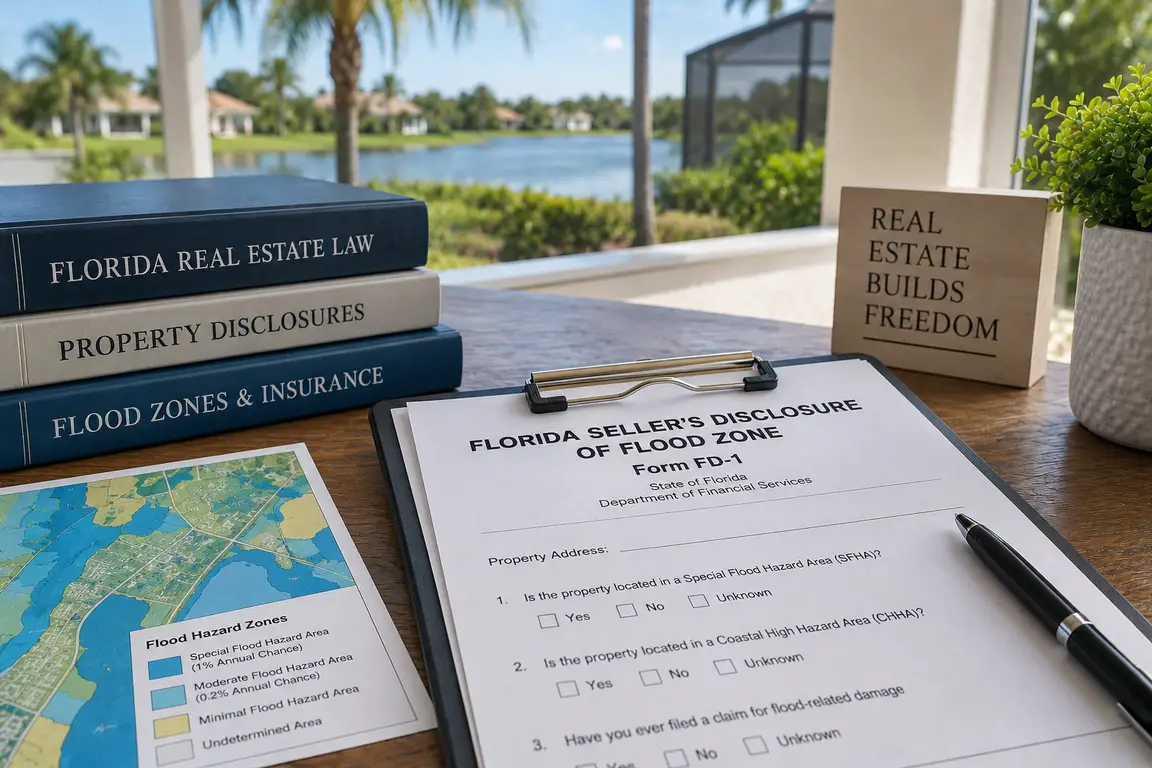
Most Florida land sellers have never heard of the FD-1 form — and until recently, they didn’t need to. That changed in 2024, when Florida created a statewide flood disclosure requirement, and it changed again in October 2025, when the requirement expanded. What surprises a lot of sellers, and even some agents who mostly work with homes, is that this disclosure law applies to vacant land, not just houses.
If you own raw land in Florida and you’re thinking about listing it, here’s what the flood disclosure law actually requires, whether it applies to your parcel, and how to handle it correctly so it doesn’t slow down your closing.
What Is the FD-1 Flood Disclosure Form?
The FD-1 is a standardized form created by Florida Realtors in response to a new state law, Florida Statute 689.302, which took effect October 1, 2024. It requires sellers of residential real property to disclose certain flood-related history to buyers before or at the time a sales contract is signed.
In its original form, the law required sellers to disclose:
- Whether they have ever filed an insurance claim for flood damage to the property
- Whether they have ever received federal assistance (such as FEMA funds) for flood damage or flood-related repairs
Then, effective October 1, 2025, the requirement expanded. Sellers must now also disclose any flood damage that occurred during their ownership of the property — regardless of whether a claim was ever filed. That’s a meaningful change: a seller who paid out of pocket for flood-related repairs, or who never repaired flood damage at all, can no longer stay silent just because they didn’t go through insurance.
Does This Apply to Vacant Land?
Yes. This is the part that catches Florida land sellers off guard. The statute covers residential real property transactions broadly, and that includes vacant residential land, not just improved homes or condos. If you’re selling a buildable residential lot, a rural homesite, or acreage zoned residential, the FD-1 requirement almost certainly applies to your sale.
The law does carve out some transaction types — new construction sold by a builder has its own disclosure path, and the rule doesn’t apply to rentals or commercial property. But a typical seller-to-buyer land sale, including land sold “as-is,” falls squarely within the requirement.
Why This Matters More for Land Than People Expect
With a house, flood history is often visible or at least documented — water stains, prior renovation permits, a disclosure from the previous owner. With vacant land, flood history can be almost invisible on a site visit. A parcel that flooded during a named storm three years ago might look perfectly dry the day a buyer walks it.
That gap between what’s visible and what’s true is exactly why the law exists, and it’s exactly why skipping the disclosure is risky. Under Florida’s broader disclosure doctrine established in Johnson v. Davis (1985), sellers already have a duty to disclose known facts that materially affect a property’s value and aren’t readily observable to the buyer. The FD-1 requirement formalizes one specific piece of that duty for flood history, but the underlying principle — don’t stay quiet about something material you know and the buyer can’t easily discover — applies to land sales generally.
What Land Sellers Should Actually Do
- Fill out the FD-1 form honestly, even if the answer is “no.” If you’ve never filed a flood claim, never received federal flood assistance, and never experienced flood damage on the property, the form still needs to be completed and provided — it just documents that. An incomplete or missing form is a compliance problem regardless of what the true answers would have been.
- Think beyond insurance claims. The 2025 expansion means informal flood damage counts too. If storm water pooled on the parcel and damaged a driveway, a fence, or cleared land, and you paid for repairs yourself, that’s disclosable now.
- Check the property’s flood zone before you list. A quick FEMA flood map lookup tells you which zone the parcel sits in, which is useful context for buyers even beyond what the form technically requires. Land in a high-risk zone (like an AE or VE zone) often needs this framed proactively, not left for the buyer’s own research to surface as a surprise late in the deal.
- Provide the form at or before contract signing — not after. The law requires the disclosure at or before the time the sales contract is executed. Handing it over after the buyer has already signed doesn’t satisfy the requirement and can create legal exposure.
- Keep a copy for your records. As with any disclosure document, both sides should retain a signed copy in case questions come up during underwriting, title work, or after closing.
What Happens If a Seller Skips It?
Failing to provide the FD-1 disclosure — or providing an inaccurate one — exposes a seller to the same kind of liability that applies to any failure to disclose a known, material fact under Florida law: the buyer may have grounds to pursue damages or, in some cases, unwind the transaction. For a straightforward one-page form, that’s a disproportionate amount of risk to take on by skipping it.
This is also an area where an “as-is” contract doesn’t help as much as sellers sometimes assume. Selling a property as-is addresses its physical condition; it doesn’t erase a seller’s statutory disclosure obligation.
Where a Land Agent Earns Their Keep Here
Flood disclosure is a small piece of paperwork, but it sits inside a larger web of Florida-specific land disclosure and closing requirements — flood zones, wetlands designations, agricultural classification, easements, and more — that don’t always show up in a generic residential transaction checklist. Filling out the FD-1 form takes five minutes. Knowing when it applies, what “flood damage” actually needs to be reported, and how it fits alongside everything else a land sale requires is where working with an agent who specializes in land, rather than houses, actually pays off.
If you’re planning to sell land in Florida and want to make sure your disclosures, pricing, and paperwork are handled correctly from the start, reach out to our team or get a free valuation on your property before you list. We’ll walk you through exactly what your specific parcel requires — flood disclosure included — so nothing holds up your closing later.
