
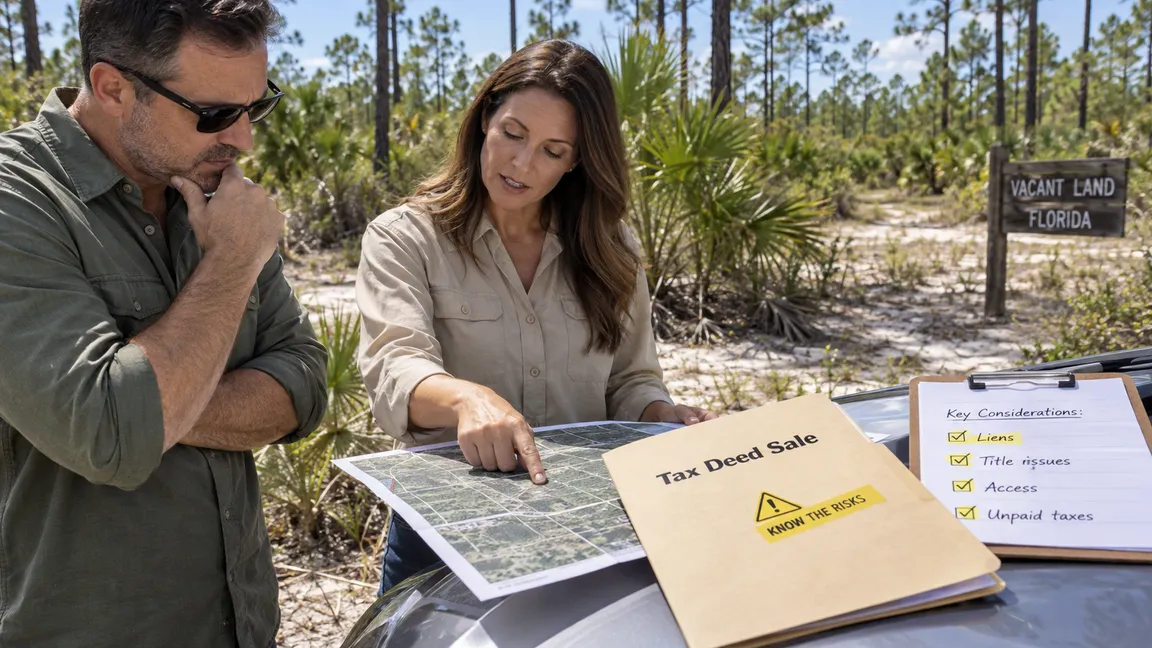
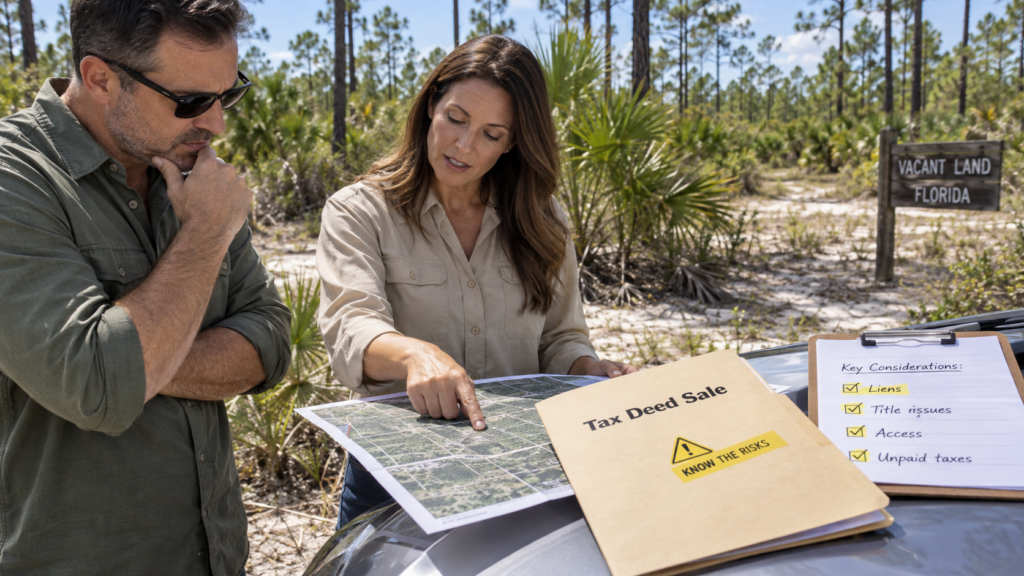
Tax deed auctions have an obvious appeal. Minimum bids are set by back taxes owed, not by market value, so listings routinely show Florida land “starting at” a few thousand dollars. You’re buying directly from the county instead of negotiating with a private seller. For a patient investor, that can be a legitimate way to acquire land below market price.
What gets left out of most “how to buy tax deed land” guides is what happens after the gavel falls. Winning the auction transfers ownership to you — but it does not automatically hand you a clean, insurable, financeable title. Understanding that gap, and what it actually costs to close it, is the difference between a smart buy and a property that sits unsellable and unmortgageable for years.
How a Florida Tax Deed Sale Works, Briefly
When a property owner falls behind on property taxes, the county sells a tax certificate to an investor willing to pay the delinquent taxes in exchange for interest. If the owner still hasn’t paid after two years, the certificate holder can apply for a tax deed, which pushes the property to public auction. The winning bidder pays at least the back taxes, accrued interest, and administrative costs, and receives a tax deed recorded by the county.
That deed proves the county transferred the property to you. It does not, by itself, prove that no one else has a valid claim on it.
The Myth: A Tax Deed Wipes the Slate Clean
A lot of buyers assume a tax deed sale erases every prior claim on the property the way a foreclosure sometimes does. It erases most — mortgages and most private liens are generally extinguished — but not all. IRS liens can survive with a redemption window, and municipal code-enforcement liens, other government liens, easements, and restrictive covenants often ride through the sale intact. A fresh tax deed is what real estate attorneys call “clouded title”: you own it, but the ownership isn’t yet clean enough to insure or finance.
Risk #1: You Can’t Get Title Insurance Right Away
Title insurers generally won’t issue a policy on a freshly acquired tax deed property. Without title insurance, you can’t offer a buyer the protection they’ll expect at resale, and most buyers — and virtually all lenders — will walk away from a purchase that can’t be insured. This is the risk that catches new tax deed buyers off guard most often: they plan to flip the lot in a few months and discover no title company will touch it yet.
Risk #2: Quiet Title Actions Cost Time and Money
The standard fix for clouded title is a quiet title action — a lawsuit asking a court to formally confirm your ownership and extinguish competing claims. It typically involves attorney fees in the low thousands of dollars and can take several months from filing to final judgment, longer if anyone with a claim contests it or is hard to locate and serve. Some buyers instead wait out a multi-year “seasoning” period, after which some title companies will insure without a quiet title action — but that means holding an unsellable asset for years in the meantime.
Risk #3: Financing Is Difficult Until Title Clears
Because of the clouded-title problem, most lenders won’t finance a tax deed property until title has been quieted or seasoned. If your plan depends on refinancing to pull cash out, or on your eventual buyer getting a mortgage, build that delay into your timeline. Cash buyers are typically the only realistic exit until title is resolved.
Risk #4: Surviving Liens and Surprises
Even after most liens are wiped out, it’s worth confirming what survives before you bid, not after you win. Code enforcement liens for things like unpermitted structures or overgrowth violations can attach to the property and follow it to a new owner. IRS liens carry a federal redemption right. And because tax deed properties are sold largely sight-unseen from a legal standpoint, buyers occasionally discover access issues, wetlands, or other physical constraints only after they already own the parcel.
Risk #5: Regulatory Timelines Can Shift
Florida’s tax deed process is set by statute, but the details — redemption windows, notice requirements, and related timelines — are the kind of thing the legislature revisits periodically. Treat any specific deadline you’re relying on as something to verify with the county clerk or a real estate attorney at the time you bid, rather than something to assume is unchanged from a prior year’s auction.
How to Protect Yourself Before You Bid
A few habits separate tax deed buyers who do well from the ones who get stuck holding an unsellable lot:
- Pull the public records yourself, or have a title company do a preliminary search, before you bid — not after you win.
- Ask a title company in advance what it would take to insure this specific parcel, and get a rough cost and timeline for a quiet title action if one will be needed.
- Bid with the quiet title cost and holding period already factored into your number, not treated as a surprise expense afterward.
- Budget for the possibility that you’re a cash-only owner for a year or more.
- Loop in a Florida land agent or real estate attorney who has actually handled post-tax-deed sales — the process of eventually reselling a formerly clouded title is its own skill set. If you’re deciding whether you need that kind of representation at all, our guide on buyer’s agents for Florida land walks through when it’s worth it.
When Tax Deed Land Still Makes Sense
None of this means tax deed sales are a bad way to buy Florida land — plenty of investors do it successfully every year. It means the “starting bid” price isn’t the real cost of ownership. The real cost includes the legal work to make the title clean enough to sell or finance later. If you go in pricing that in from the start, and you’re not in a hurry to resell, a tax deed purchase can still be one of the more efficient ways to acquire Florida land below market. For a broader look at what to budget for as a buyer more generally, see what to know before buying land in Florida, and if you’re comparing the auction route to a traditional purchase, our step-by-step look at tax deed auctions covers the bidding process itself in more detail.
If you’re weighing a tax deed purchase against buying through a traditional listing — or you’ve already won a parcel and need help sorting out next steps — reach out and we can walk through what makes sense for your situation.
