
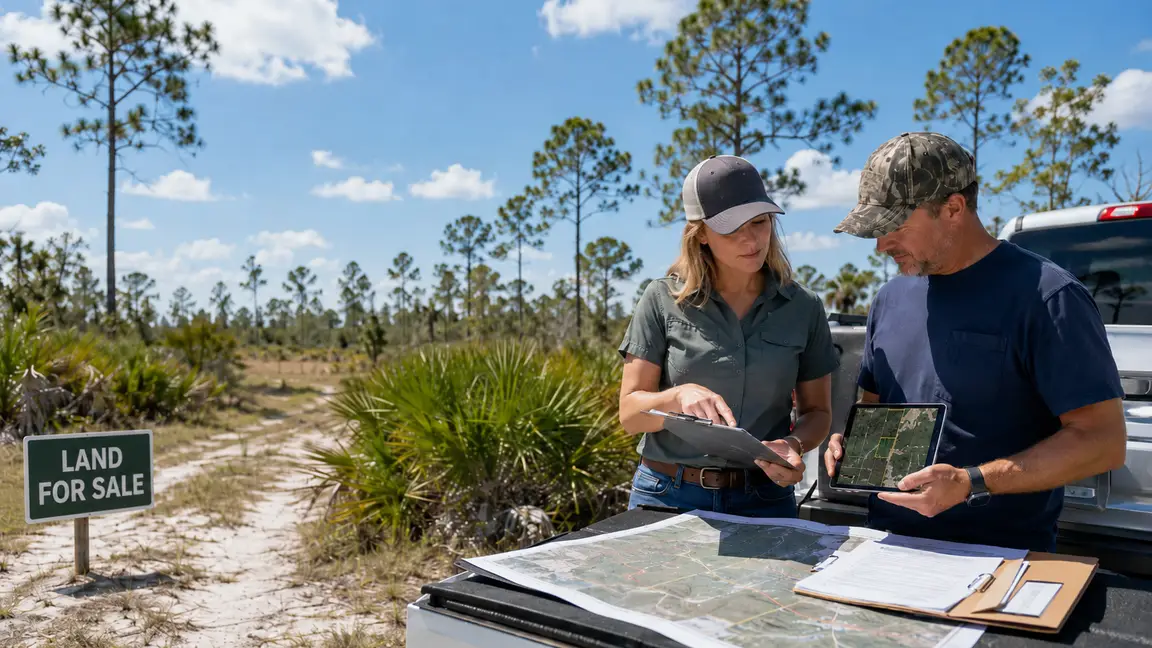
Selling vacant land in Florida is not the same as selling a house, and it is not the same as it was three years ago. During the 2021–2022 boom, well-located lots sold almost as fast as they hit the market. In 2026, the picture is more measured: after several years of rapid appreciation, residential land prices leveled off through 2024 and 2025, and higher interest rates have made buyers more cautious and more price-sensitive. The good news is that Florida is still growing fast — the state added hundreds of thousands of new residents in 2024 alone — so the demand is there. You just have to run the process correctly.
Here is the step-by-step process I use as a Florida land specialist to get raw and recreational acreage sold for the most money the market will bear.
Step 1: Understand What You Actually Own
Before you can price or market a parcel, you need to know exactly what it is. Pull your deed and confirm the legal description, acreage, and parcel ID with the county property appraiser. Then dig into the details that drive value:
- Zoning and land use — what can a buyer legally build or do there?
- Access — is there legal, recorded road access, or is the parcel landlocked?
- Utilities — are water, sewer, and power at the road, or is this a well-and-septic situation?
- Wetlands and flood zone — a large wetland footprint or a high-risk flood designation changes the buyer pool.
- Restrictions — HOA rules, conservation easements, or deed restrictions can all affect price.
Buyers of vacant land are buying potential, and the more clearly you can describe that potential, the faster the parcel moves. Gaps in this information are one of the most common reasons a listing stalls.
Step 2: Price It to the 2026 Market, Not the 2022 Market
Pricing is where most for-sale-by-owner listings go wrong, and it is even more important now that buyers are comparing options carefully. Florida land values vary enormously by location — rural panhandle and north-central parcels can run a few thousand dollars an acre, while developable lots near Orlando, Tampa, and the coasts can run many times that. Statewide averages are close to useless for a single parcel.
The right price comes from recent, comparable, closed sales of similar land in your immediate area — similar size, zoning, access, and utility situation — adjusted for current conditions. Active listings tell you what sellers are hoping for; closed sales tell you what buyers actually paid. If you want a fast, no-pressure starting point, you can find out what your land is worth before you commit to a number.
A correctly priced parcel in 2026 still sells. An aspirational price sits, goes stale, and eventually sells for less than it would have with a sharp price from day one.
Step 3: Prepare the Land to Show Well
Land has curb appeal, too, and a little preparation goes a long way. Where it is safe and legal to do so, clear debris, mow or bush-hog overgrowth, and make sure the boundaries are identifiable. If the parcel has a standout feature — a pond, mature oaks, a cleared building pad, road frontage, or a long view — make sure it is visible and easy to reach when a buyer walks the property.
The goal is simple: help the buyer picture themselves using the land. A parcel that looks cared for signals that the rest of the transaction will be clean too.
Step 4: Build a Listing That Sells the Potential
A vacant-land listing lives or dies on its presentation. The strongest listings include:
- High-quality photos, including aerial or drone shots that show the lot in context
- A clear plat or parcel map with boundaries marked
- A specific, factual description covering acreage, zoning, access, utilities, and what the parcel is suited for
- Honest notes on flood zone, wetlands, or restrictions so the right buyers self-select
Generic “great investment opportunity” copy does nothing. Buyers searching for land in Florida are usually looking for something specific — a homesite, a hunting tract, agricultural acreage, or a development play — and your listing should speak directly to whichever one fits your parcel. For more on what separates a parcel that moves from one that lingers, see 9 fixes to apply if your Florida land is not selling.
Step 5: Get It in Front of Real Buyers
Listing on the MLS is the single biggest lever, because the MLS syndicates to Zillow, Realtor.com, LandWatch, and dozens of other sites where serious buyers search. Beyond that, a good marketing push for land includes targeted online ads, social media, and direct outreach to local builders, investors, and adjacent landowners — neighbors are often the most motivated buyers of all.
This is one of the clearest advantages of listing with an agent rather than going it alone. A specialist already has the MLS access, the syndication, and the buyer network in place. You can see how we market and list Florida land to compare it against doing it yourself.
Step 6: Negotiate Offers and Terms
When offers come in, price is only part of the story. Pay attention to:
- Financing vs. cash — cash and large down payments reduce the risk of a deal falling through.
- Contingencies — due diligence periods, survey, and feasibility contingencies are normal for land, but watch the length.
- Owner financing — offering to finance the sale yourself can widen your buyer pool significantly, since many land buyers cannot get conventional bank loans on raw parcels. Just make sure the terms are documented properly.
A strong agent helps you read between the lines of competing offers so you are comparing them on more than the top-line number.
Step 7: Know Your Closing Costs Before You Sign
Florida sellers typically cover several closing costs, and you should factor them in before you set your bottom line:
- Documentary stamp tax on the deed — $0.70 per $100 of the sale price in most counties (Miami-Dade is structured differently). On a $100,000 parcel, that is about $700.
- Owner’s title insurance — in Florida, the seller customarily pays for the buyer’s owner’s title policy, at state-promulgated rates.
- Title search, closing, and lien payoffs — plus any outstanding property taxes prorated to the closing date.
- Real estate commission — note that since the 2024 NAR settlement, agent compensation is negotiated and disclosed differently than it used to be. If you are not clear on how that works now, read how Florida land commissions really work in 2026.
Knowing these numbers up front means no surprises on the closing statement.
Step 8: Close the Deal
The closing itself is handled by a title company or real estate attorney, who clears the title, prepares the deed, collects and disburses funds, and records the transaction with the county. For a clean parcel with no title issues, land closings are usually straightforward. The work you did in Step 1 — confirming the legal description, access, and clear title — is what keeps this final step smooth.
How Long Does It Take to Sell Land in Florida?
There is no single answer, because it depends on price, location, and how well the parcel is marketed. A sharply priced, well-presented lot in a desirable area can go under contract in weeks. A rural parcel with access or zoning complications can take several months, even in a healthy market. The two biggest factors you control are pricing and exposure — get both right and you compress the timeline dramatically.
Ready to Sell Your Florida Land?
Selling land in Florida in 2026 is absolutely doable, but it requires a deliberate process: know your parcel, price it to today’s market, present it well, and get it in front of the right buyers. If you would rather have a Florida land specialist handle the heavy lifting — pricing, MLS listing, marketing, negotiation, and closing — I would be glad to help. Reach out today for a straight-talk conversation about what your land is worth and how to get it sold. (813) 540-4841
