
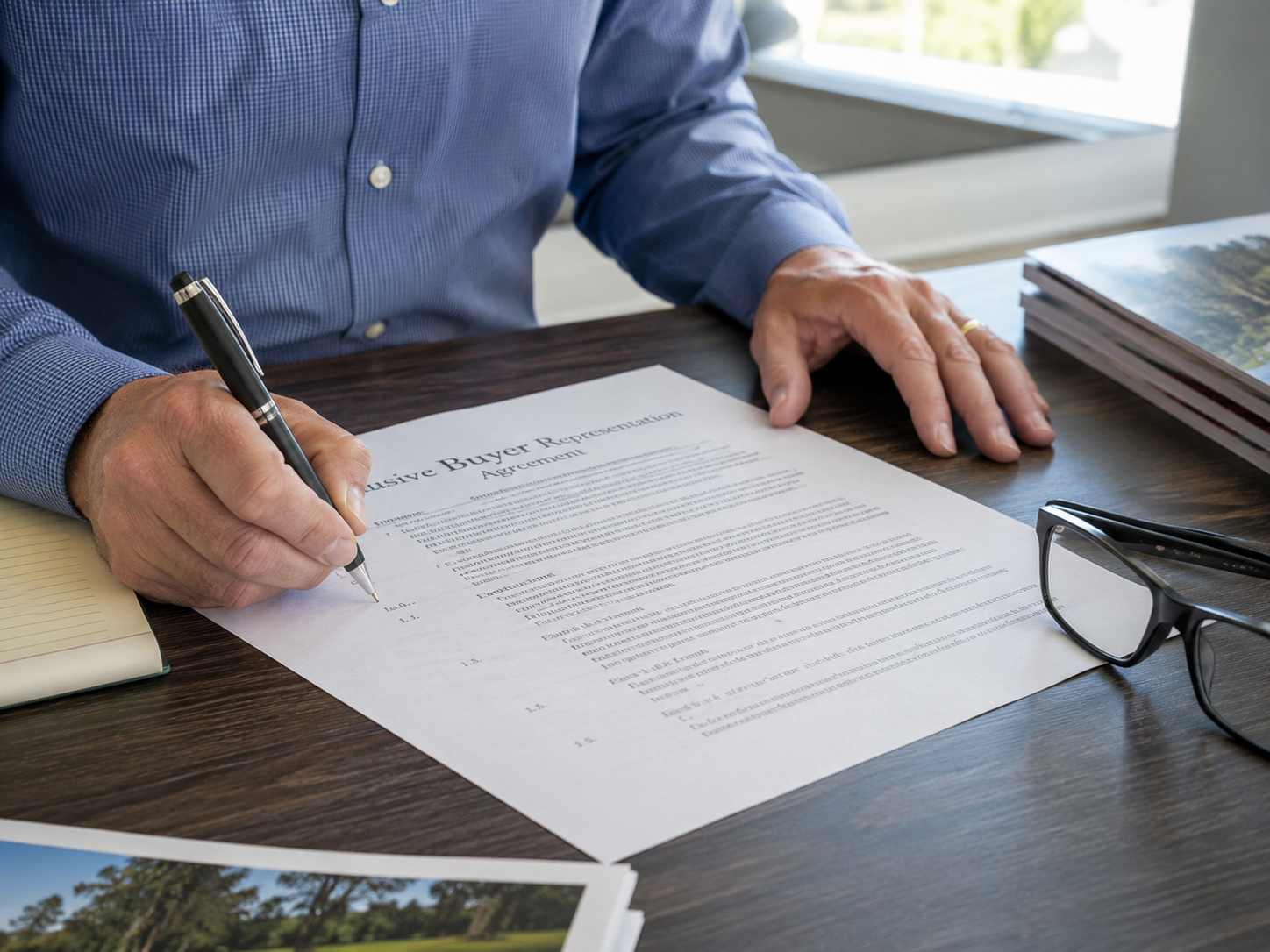
If you are buying or selling Florida land in 2026, the way real estate commissions work is not the same as it was two years ago. The August 2024 National Association of Realtors (NAR) settlement, combined with Florida-specific guidance issued by Florida Realtors, has changed how agent compensation is disclosed, negotiated, and paid — for both sides of the transaction.
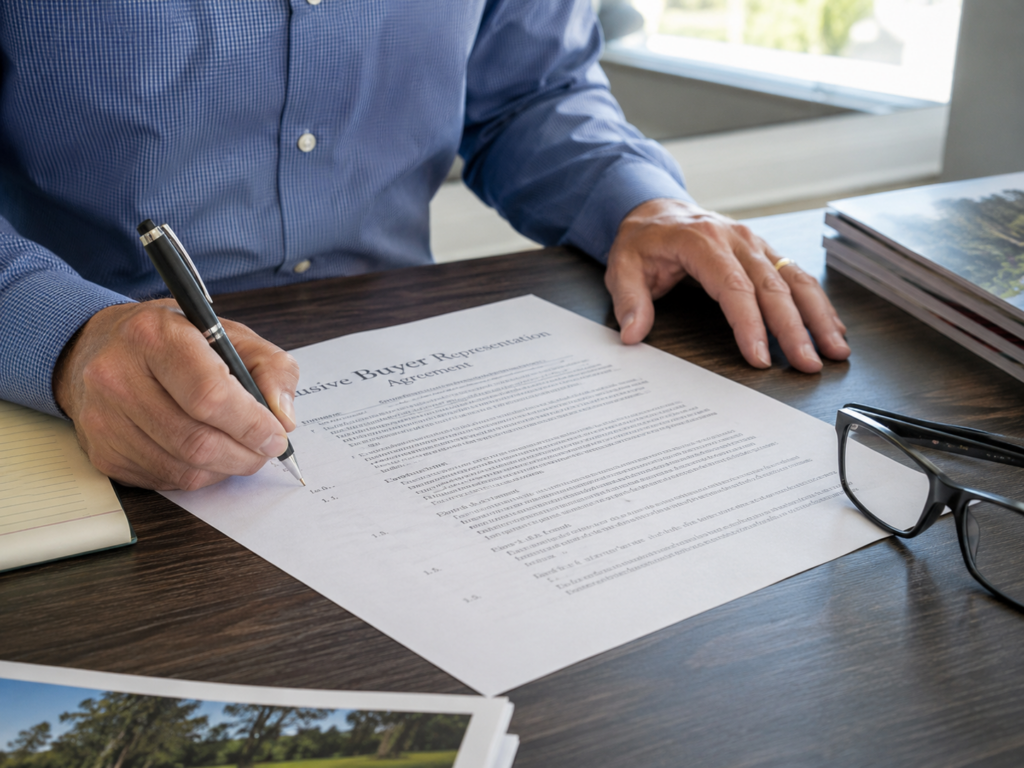
This is the most common question I get from new clients: Who pays the agents? How much? And what does the buyer agreement I have to sign actually mean?
Here is a plainspoken breakdown of how Florida land commissions work in 2026, what changed, and what you should ask before signing anything.
What changed in the NAR settlement
In March 2024, NAR agreed to a $418 million settlement of antitrust lawsuits brought by home sellers. The terms — which took effect August 17, 2024 — required two structural changes that still govern how Florida agents do business in 2026:
- Multiple Listing Services (MLSs) can no longer publish offers of compensation to buyer brokers. The old field on the listing — “seller offers 3% to buyer’s agent” — is gone. Any conversation about buyer-side compensation has to happen off-MLS, agent to agent or agent to buyer.
- Buyers must sign a written representation agreement before touring properties with an agent. That agreement has to state the exact compensation amount or rate in objective terms (a flat fee, percentage, or hourly rate), and it has to make clear that commissions are negotiable and not set by law.
For Florida, these rules apply to any MLS-listed transaction — which is almost every traditional land listing in the state.
What sellers of Florida land actually pay in 2026
When you list vacant land with an agent in Florida, you sign a listing agreement that spells out what you are paying your listing agent (the one representing you). That number is fully negotiable and varies by parcel size, price point, and how much marketing the property needs. Typical ranges for vacant land in Florida currently run between 6 percent and 10 percent total — higher than residential because land takes longer to sell and requires more specialized marketing on platforms like LandWatch, Lands of America, and Land.com.
What is different in 2026 is the buyer side. Sellers are no longer assumed to pay the buyer’s agent commission. You can:
- Offer a buyer-broker concession. Many sellers still choose to do this because it widens the buyer pool — most buyers cannot bring extra cash to the table to pay their own agent. Your listing agent will advise on what is competitive in your market.
- Refuse to offer any concession. This narrows your buyer pool to cash-strong buyers or buyers willing to pay their agent directly out of pocket. For low-priced rural land (under $30,000), this is becoming more common.
- Negotiate it at the offer stage. The buyer can ask for a credit toward their agent’s fee as part of their offer, and you decide whether to accept.
The right answer depends on your parcel and your timeline. If you want to talk through the math on your specific property, request a free land valuation and we can walk you through it.
What buyers of Florida land actually pay in 2026
If you are buying Florida land, the new rules mean you will sign a buyer representation agreement before your agent shows you property. That agreement states what you would owe your agent if the seller does not cover it. In practice, three scenarios play out:
- Seller offers a concession that covers your agent’s fee. This is still the most common outcome on listed land — you pay your agent nothing out of pocket because the seller agreed to a buyer-broker credit at closing.
- Seller offers a partial concession. You and your agent agreed to 3 percent in the buyer agreement, but the seller will only credit 2 percent. You owe the difference at closing — or you negotiate it into your offer price.
- Seller offers nothing. You pay your agent the full amount you agreed to in your buyer representation agreement, out of pocket at closing.
The takeaway: read the buyer representation agreement carefully, understand what you are committing to, and make sure your agent is upfront about how concessions will be handled if a seller does not cover the fee.
Are commissions really negotiable?
Yes. They always have been — the NAR settlement just made that more explicit. The number on the listing agreement is a starting point, not a rule. What you can reasonably negotiate depends on:
- Parcel value. A $500,000 listing supports a different commission structure than a $15,000 lot.
- Time on market expectations. Easy listings (popular county, good road frontage, clear title) can sometimes go for less. Listings that will require months of targeted marketing usually warrant the full rate.
- Marketing scope. Are we putting it on three MLSs and four land portals with professional drone photography, or is it a quick MLS upload? Scope drives price.
- Your situation. If you need to close in 30 days for tax or estate reasons, that limits leverage. If you can wait nine months for the right buyer, you have more room.
Ask any agent — including me — to break down what they are actually doing for the fee. If they cannot explain it, you have your answer.
What to look for in a Florida land agent’s commission disclosure
Whether you are a buyer or seller, here is what the paperwork should clearly say:
- The compensation amount or rate. A specific number, not a range.
- How it is paid. Percentage of sale price, flat fee, or hourly.
- Who pays it. Seller, buyer, or a combination — and the contingency if the seller does not cover it.
- The term. How long the agreement lasts, and what happens if you terminate early.
- A statement that the fee is negotiable. This is now required language.
If any of those items are vague or missing, do not sign yet. Ask for clarification in writing.
How this plays out on vacant land specifically
Land transactions are not the same as residential closings, and a few wrinkles matter in 2026:
- Lower-priced parcels. On a $10,000 rural lot, a 6 percent commission is $600 — barely enough to cover marketing. Many land agents now use flat fees on parcels under $25,000.
- Off-market buyers. A real Florida land specialist often has a buyer list independent of the MLS — adjacent landowners, recreational buyers, investors. Those deals are sometimes structured with reduced commissions because no buyer agent is involved.
- Owner-financed sales. If you are seller-financing a parcel, the commission is paid at closing on the down payment plus the financed amount — not just the cash you receive day one. Confirm this in the listing agreement.
- Auction or wholesale paths. If your parcel is hard to sell traditionally, ask your agent about alternatives. We can also compare a traditional listing to a direct cash offer so you have full visibility into your options.
Final advice
The 2026 commission landscape rewards informed buyers and sellers. The agents who built their careers on opaque commission math are the ones complaining about the changes. The agents who already worked transparently — explaining exactly what they do and what it costs — find the new rules easier, not harder.
If you are listing Florida land, your job is to pick a specialist who can justify their fee with a clear marketing plan and a track record on parcels like yours. If you are buying, your job is to read the buyer representation agreement before you sign it and understand what happens if the seller will not cover the buyer-side fee.
Either way, do not assume. Ask the question, get it in writing, and negotiate. You are the client.
If you want to talk through commissions on a specific Florida parcel — yours to sell or one you are trying to buy — reach out to our team or call (813) 540-4841. We will give you a straight answer.
