
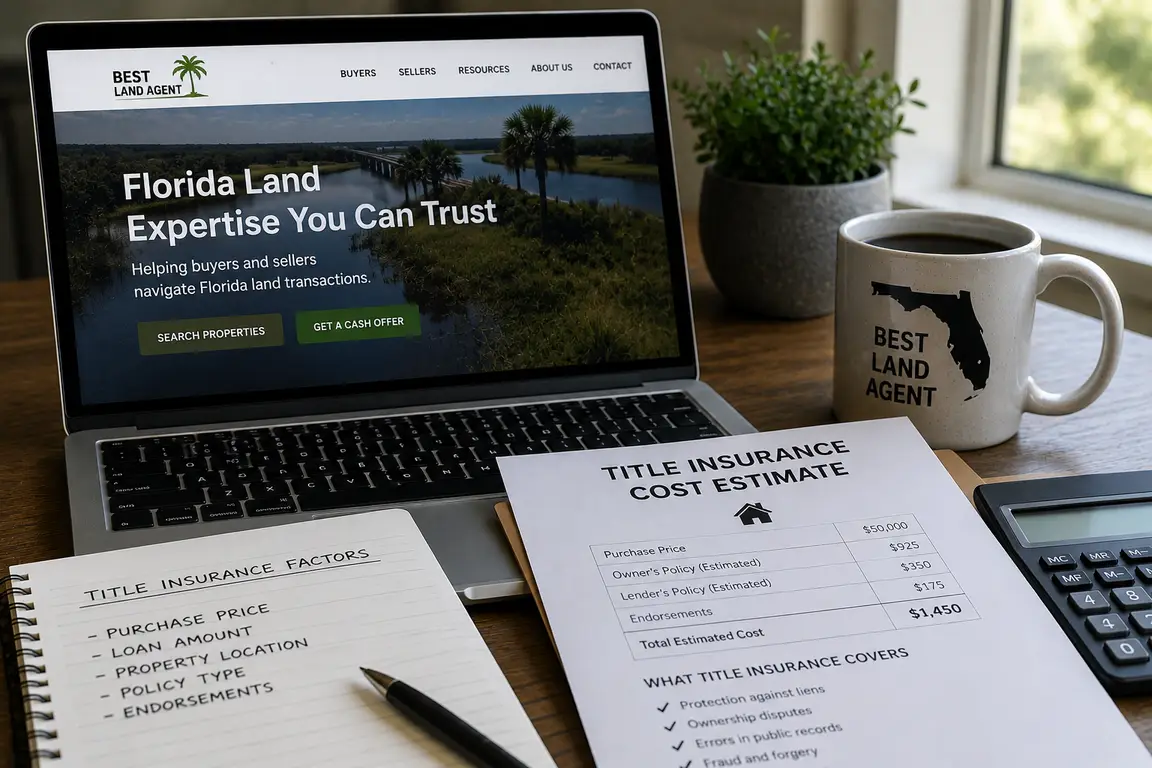
Ask five different people what title insurance costs in Florida and you’ll get five different guesses — usually wrong ones. That confusion is understandable for home buyers, but it’s even more common among land buyers, who often assume vacant land either doesn’t need title insurance or gets priced completely differently than a house. Neither is true, and the actual math is more predictable than most people expect.
Here’s what title insurance really costs on a Florida land purchase in 2026, why the price isn’t up for negotiation the way most closing costs are, and what actually does vary from one transaction to the next.
Florida’s Title Insurance Rates Are Set by the State, Not the Market
Florida is one of a small number of “promulgated rate” states, meaning the Florida Office of Insurance Regulation — not individual title companies — sets the premium for owner’s and lender’s title insurance policies. Every licensed title agency in the state charges the same base rate for the same coverage amount. Shopping around for a lower title insurance premium the way you’d shop for a lower interest rate simply doesn’t work here; the rate is fixed by law no matter which title company or attorney handles your closing.
What does vary between title companies is everything around the premium: closing fees, search fees, endorsement charges, and service quality. That’s worth comparing. The insurance premium itself is not.
What Title Insurance Actually Costs in 2026
The current promulgated rate for an owner’s title insurance policy in Florida is:
- $5.75 per $1,000 of coverage on the first $100,000 of the purchase price
- $5.00 per $1,000 of coverage on each dollar from $100,001 up to $1,000,000
- A $100 minimum premium applies regardless of purchase price
In practice, that works out to a few easy reference points for land buyers:
- A $50,000 vacant lot: roughly $288 in owner’s title insurance
- A $200,000 parcel: roughly $1,075
- A $500,000 property: roughly $2,575
- A $1,000,000 tract: roughly $5,075
These numbers are identical whether the property is a quarter-acre residential lot, forty acres of timberland, or a house — the rate is based purely on purchase price, not property type. The one meaningful exception is that lower-value rural and agricultural parcels sometimes fall entirely within the $5.75-per-$1,000 first-tier rate, which is why smaller land deals can have a proportionally higher premium than a similarly priced fraction of a larger transaction.
Owner’s Policy vs. Lender’s Policy — And Why You Might Need Both
There are two separate title insurance policies that can come up in a land purchase, and mixing them up is where a lot of the cost confusion starts.
Owner’s title insurance protects the buyer. It stays in effect for as long as the buyer or their heirs own the property, and it covers issues like undisclosed liens, forged signatures in the chain of title, or boundary and access disputes that surface after closing. This is the policy priced on the schedule above.
Lender’s title insurance protects the mortgage company, not the buyer, and is required any time the purchase is financed. If you’re buying land with a loan, expect the lender to require this policy as a condition of funding. When it’s purchased at the same time as the owner’s policy — which is standard practice — it’s typically issued at a simultaneous-issue rate that’s far lower than a stand-alone lender’s policy, often adding only a modest amount to the total premium rather than doubling it.
Cash buyers can skip the lender’s policy entirely, since there’s no lender to protect. But skipping the owner’s policy to save money is a different decision — one worth thinking through carefully, since it’s the policy that actually protects you.
Who Pays for Title Insurance on a Florida Land Purchase?
Florida doesn’t have a statewide rule dictating whether the buyer or seller pays for the owner’s title insurance policy. Instead, it comes down to local county custom, and it’s always negotiable within the purchase contract. In much of the state it’s customary for the seller to pay and to select the title company; in other counties, particularly parts of South and Southwest Florida, buyer-paid title insurance is more common. Neither approach is required by law — it’s simply what local practice has settled on, and either party’s real estate agent should be able to tell you the norm for the specific county where the land sits.
Because the premium itself is fixed regardless of who pays, this is really a negotiating question about which side absorbs a known, fixed cost — not a question about controlling the price.
Does Vacant Land Cost More to Insure Than a House?
Not because of the coverage rate, which is identical. But vacant land title searches can occasionally turn up more complexity than a typical single-family home resale — things like unresolved mineral rights, old easements, timber rights, or gaps in the chain of title on parcels that haven’t changed hands in decades. When a title search uncovers one of these issues, it can mean additional curative work (and sometimes additional endorsement fees) before a policy can be issued cleanly. That’s not a change to the base premium, but it is a real cost some land buyers don’t anticipate, and it’s one more reason a title search on raw land is worth taking seriously rather than treating as a formality.
How to Make Sure You’re Not Overpaying
Since the insurance premium itself can’t be shopped, focus your comparison shopping on the parts of the closing that do vary:
- Closing and settlement fees charged by the title company or closing attorney
- Search and exam fees for researching the property’s title history
- Endorsement fees for any additional coverage riders your situation requires
- Recording fees, which are set by the county but should be itemized clearly, not bundled into a vague “closing costs” line
A detailed closing disclosure should break every one of these out separately from the title insurance premium. If a title company’s estimate lumps them together, ask for an itemized version before you commit.
Getting the Right Coverage on Your Next Florida Land Purchase
Title insurance is one of the few genuinely fixed, predictable costs in a Florida land transaction — which makes it one less thing to negotiate over and one more thing to simply plan for correctly. The real risk isn’t overpaying for the policy; it’s skipping it, or not understanding what it covers, on a piece of land where the title history is more complicated than it looks on the surface.
For a deeper look at how title insurance fits into the broader closing process — including the paperwork you’ll encounter along the way — see our full title insurance guide for Florida land buyers and sellers. And if you’re getting ready to buy or list land in Florida and want a second set of eyes on the numbers, reach out to our team — we’re happy to walk through what your specific transaction is likely to cost, county by county.
