
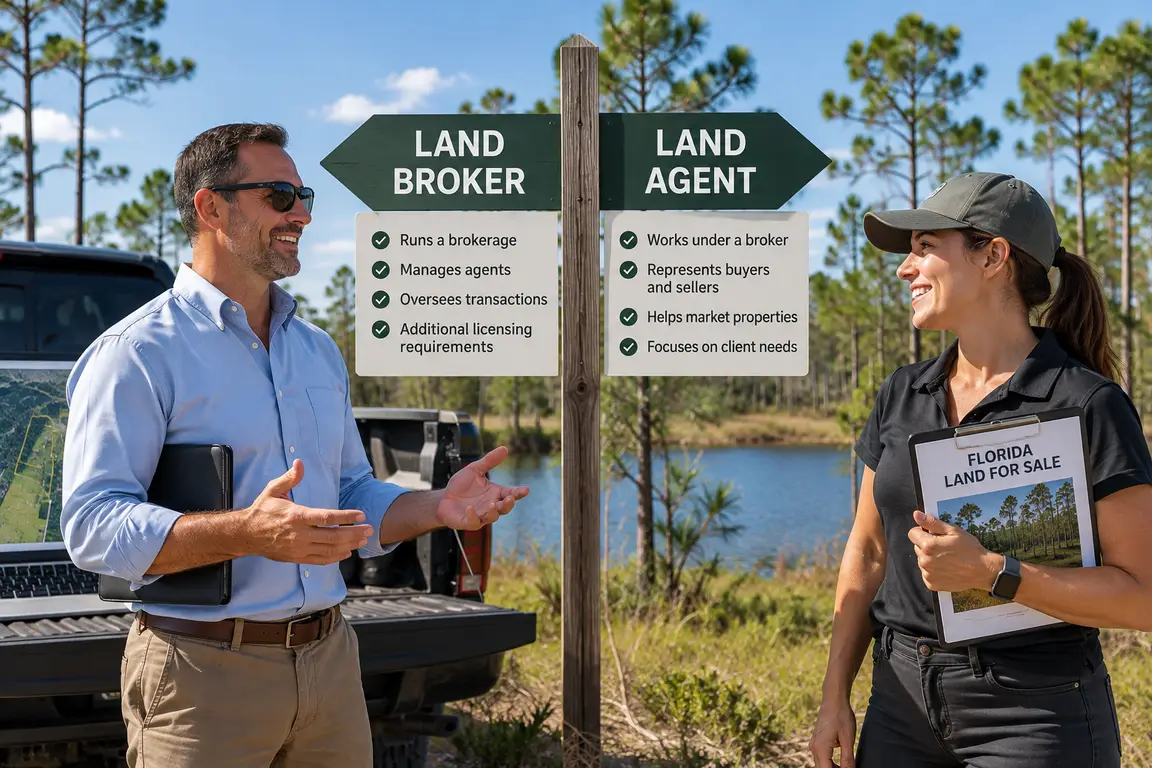

Florida’s real estate license law recognizes exactly two categories of licensees: the sales associate — commonly called an “agent” — and the broker. Everyone who lists, shows, or negotiates the sale of land in Florida holds one of those two licenses. But the terms get thrown around so loosely online that most sellers and buyers never learn what actually separates them, or whether it should factor into who they hire.
Search anything like “land broker near me” or “best land brokerage” while shopping for representation, and the results blur agents, brokers, and brokerages together as if they were interchangeable. They’re not entirely interchangeable. And for land specifically — where deals hinge on things like zoning research, access easements, and county-by-county comps that don’t show up in a standard home search — the distinction is worth five minutes of your attention before you sign anything.
What a Sales Associate (Agent) Actually Does
A sales associate is licensed to list property, show property, and negotiate transactions, but only while working under the supervision of a licensed broker. In Florida, every sales associate’s license is attached to a specific broker or brokerage, and that broker carries legal responsibility for the transactions the associate handles. When most people say “my real estate agent,” they mean a sales associate.
To become a sales associate in Florida, the state requires 63 hours of pre-licensing coursework, a passing score on the state exam, and a background check. It’s a meaningful bar to clear, but it’s the entry-level license in the profession. Brokers have cleared it and then some.
What a Broker Does Differently
A broker has completed additional experience and education requirements on top of the sales associate license. Current Florida requirements include at least 24 months of active experience as a sales associate within the prior five years, 72 hours of broker-level coursework, sales associate post-license education, a separate and more comprehensive state exam, and a fingerprint background check. A broker can work independently, operate their own brokerage, and supervise other sales associates. Every brokerage in Florida — no matter how large — has to be headed by at least one licensed broker of record.
That’s the technical distinction. In practice, it shows up in a few ways that matter to a land seller or buyer:
- A broker has, by definition, at least a couple of years of transaction experience beyond the entry-level license, plus a harder exam behind them.
- A broker is accountable for compliance on every file that runs through their brokerage — which is part of why plenty of experienced sales associates deliberately stay associates rather than pursue a broker’s license. The added liability isn’t worth it to everyone, regardless of how many deals they’ve closed.
- Some brokers work directly with clients day to day, the same as an associate would. Others focus almost entirely on running the brokerage and let their associates handle listings and showings.
None of this means a broker is automatically the better choice for your transaction. It mostly tells you about someone’s licensing tier and career stage — not how many land deals they’ve actually closed.
Why Land Specialization Matters More Than the Title
Here’s the part that gets lost in most broker-versus-agent explainers: for land specifically, the license tier matters less than whether the person actually works in land day to day. Florida’s real estate market is overwhelmingly built around single-family homes and condos. Most agents — and plenty of brokers — spend their careers in residential resale and rarely touch a vacant parcel. That’s a real problem, because land sells differently than houses do.
Land comps are thinner and harder to pull than home comps. Pricing depends on zoning, wetlands, road access, and utility availability in ways a standard home valuation model doesn’t capture. Buyers ask different questions — about perc tests, easements, mineral rights, and agricultural classification — that a home-focused agent may rarely field. A broker with fifteen years of experience listing subdivisions isn’t automatically better equipped to price a 20-acre timber tract than an associate who’s spent three focused years doing nothing but land.
So when you’re weighing “land agent” against “land broker” as options, the more useful filter usually isn’t the license tier. It’s whether land is genuinely the person’s specialty, and whether they can point to recent, comparable land closings in your county.
Consider two hypothetical listings: a broker who has run a successful residential brokerage in Tampa for a decade, and a sales associate with three years of experience who has personally closed two dozen vacant land deals across three rural counties. On paper, the broker holds the higher license. For a raw land seller, the associate is very likely the better fit — because they’ve already seen the specific problems that come up with land (a buyer’s lender balking at an unrecorded easement, a parcel that loses value once a wetlands delineation comes back, a price that looked fine until the agricultural classification rollback tax showed up at closing) and knows how to work around them before they blow up a deal.
Where “Realtor” Fits Into All of This
One more term adds to the confusion: Realtor. A Realtor isn’t a separate license tier — it’s a trademarked designation that belongs to members of the National Association of Realtors, and it can apply to sales associates and brokers alike. A Realtor has agreed to follow NAR’s Code of Ethics and typically has access to the local MLS through their board membership. So a “land Realtor” could hold either a sales associate license or a broker’s license; the Realtor label speaks to professional association membership, not to which of the two state licenses they carry. If you see “Realtor” and “broker” or “Realtor” and “agent” used together in someone’s bio, that’s why — they’re describing two different things at once, not contradicting themselves.
Questions to Ask Before You Hire Either One
Whether you’re talking to a sales associate or a broker, the same questions separate a real land specialist from a generalist who happens to have a listing slot open:
How many vacant land transactions have you closed in the past 12 months, and where? A specific number and specific counties beat a vague “quite a few, over the years.”
How do you price land without a standard comp set? Listen for an actual methodology — recent land sales, price-per-acre trends by zoning type, adjustments for access and utilities — not just “I’ll run some numbers and get back to you.”
Do you handle land-specific paperwork yourself, or does it get outsourced? Agricultural classification, easement documentation, and flood disclosure requirements are easy to get wrong if they’re unfamiliar territory for whoever is handling your file.
Who actually markets the property — you, or someone else on the team? At larger brokerages, it’s common for an associate to do the day-to-day work under a broker’s license and oversight. That’s normal and not a red flag, but you should know upfront who you’re actually working with.
The Bottom Line for Florida Land Sellers and Buyers
The broker-versus-agent distinction is a real one under Florida licensing law. Brokers have cleared a higher experience and education bar, and they carry legal responsibility for their brokerage’s transactions. But it’s not the distinction that determines whether someone will do a good job selling your land or finding you the right parcel. That comes down to land experience specifically — recent closings, familiarity with your county, and a pricing approach built for raw land rather than borrowed from home sales.
If you’re comparing a land broker and a land agent for the same job, ask both the same questions above and let the answers — not the title on the business card — make the decision for you.
Whether you’re ready to list a property or just want a sense of what it’s worth, working with someone who specializes in Florida land makes the process faster and less stressful, no matter which license they hold. Get in touch with our team or start with a free land valuation to see what your land could be worth in today’s market.
